

Wedding party photography is one of the most rewarding—and challenging—parts of photographing a wedding. These are the moments when the entire bridal party, from bridesmaids and groomsmen to family and close friends, gathers together to celebrate. The laughter, inside jokes, and genuine connections are what make these photos timeless treasures for couples.
In this guide, we’ll dive into the most effective wedding party photography tips that both beginner and professional photographers can apply. You’ll learn how to plan, pose, and manage large groups with ease while keeping everyone relaxed and having fun. We’ll also cover lighting, timing, editing, and creative ideas that make your photos stand out in any wedding album.
Here’s what you’ll discover in this post:
- ✅ How to plan your wedding party shots like a pro
- ✅ The best posing, composition, and lighting techniques
- ✅ Proven workflow tips for capturing group photos efficiently
- ✅ Common mistakes and how to avoid them
- ✅ Creative ideas and FAQs about wedding party photography
“A great wedding party photo isn’t just about perfect smiles—it’s about capturing the spirit of the celebration.” — Anonymous Wedding Photographer
Whether you’re capturing a rustic outdoor ceremony or an elegant ballroom wedding, these wedding party photography tips will help you deliver stunning, memorable images that couples love to share and frame.
Let’s start by understanding exactly what wedding party photography means and why it’s such a vital part of every wedding album.
What Is Wedding Party Photography?
Wedding party photography is more than just capturing a group of people standing together—it’s about telling the story of the couple’s closest relationships. The wedding party usually includes the bridesmaids, groomsmen, maid or matron of honor, best man, flower girls, ring bearers, and sometimes even close family or lifelong friends. These are the people who play a vital role in supporting the couple, both emotionally and logistically, throughout the wedding journey.
In photography terms, the wedding party photos often become some of the most cherished images in the album. They capture friendship, excitement, and unity. More importantly, they reveal the couple’s personality and the tone of the celebration—formal, fun, or heartfelt.
Defining the Wedding Party
A wedding party can vary greatly depending on cultural traditions and personal preferences. In a traditional Western wedding, for example, you might have:
| Role | Description |
| Bridesmaids | Close friends or relatives of the bride who help with preparations. |
| Groomsmen | Friends or family of the groom who assist with logistics and ceremony duties. |
| Maid/Matron of Honor & Best Man | Key support figures who coordinate events, speeches, and pre-wedding tasks. |
| Flower Girls & Ring Bearers | Younger members of the family who add charm and innocence to the ceremony. |
Some weddings include extended parties—friends from college, cousins, or mentors—making group sizes range from 6 to 20+ people. For a photographer, this means adapting to different compositions, dynamics, and personalities.
Why Wedding Party Photography Matters
High-quality wedding party photos serve as visual memories of relationships that shaped the couple’s story. They’re not just pretty portraits—they capture genuine bonds and shared emotions.
Here’s why these images are so important:
- Emotional Storytelling: They highlight laughter, camaraderie, and inside jokes between the couple and their closest circle.
- Album Balance: Group photos add contrast to intimate couple shots, providing a fuller narrative of the day.
- Social Sharing: Candid wedding party photos are often the most shared online, helping photographers gain exposure.
- Client Satisfaction: Couples often judge a photographer’s professionalism based on how well they handle and organize these complex group shots.
According to a 2023 WeddingWire survey, over 78% of couples said the “bridal party group photos” were among their top 3 most important images from their wedding day—second only to the couple’s portrait session. This statistic underscores just how crucial these shots are for building a strong photography portfolio.
The Role of a Photographer in Wedding Party Photos
A wedding photographer wears many hats during this part of the day—director, organizer, and artist. Your job isn’t only to click the shutter but also to manage people, direct poses, and ensure everyone feels comfortable and confident.
Pro Tip: Think of yourself as a “friendly director.” Give clear but positive instructions, use humor to ease tension, and stay adaptable when energy levels fluctuate. Your attitude directly affects how natural and relaxed the photos will look.
Good wedding party photography balances technical mastery (lighting, exposure, composition) with people management skills (timing, communication, mood). The best photographers blend these seamlessly, turning potential chaos into unforgettable imagery.
Pre-Wedding Planning for Great Wedding Party Shots
The secret to stunning wedding party photography begins long before the big day. Planning is where the magic happens — and where potential disasters are prevented. From creating a shot list to scouting locations, preparation ensures that when emotions are high and time is short, you can capture every perfect smile and spontaneous laugh with ease.
This section outlines the essential pre-wedding photography tips that every professional should master before stepping behind the lens.
Consult with the Couple and Wedding Planner
Before the wedding day, it’s vital to sit down with the couple and, if possible, the wedding planner. This is where you lay the foundation for smooth communication and clear expectations.
What to discuss:
- Wedding Party Details: Get the full list of wedding party members, including names, roles, and relationships. Knowing who’s who avoids confusion during group photos.
- Timeline: Ask when the bridal party will be ready for photos. This helps determine lighting conditions (morning light vs. golden hour) and scheduling.
- Shot Priorities: Find out which group combinations are non-negotiable (e.g., “bride with college friends,” “groom with siblings,” etc.).
- Venue Rules: Some venues have restrictions on flash or certain areas; confirm these early.
- Special Requests: Ask if there are surprise moments, props, or themes that should be incorporated.
“Photographers who invest time in understanding the couple’s vision often deliver photos that feel more authentic and emotionally resonant.” — The Knot Photography Trends Report 2024
By aligning expectations early, you avoid stress, ensure smoother coordination, and build trust — all key to capturing genuine, joyful moments later on.
Scout Locations and Lighting Ahead of Time
A professional photographer should always scout the wedding venue in advance. Understanding your environment helps you adapt quickly when the schedule shifts or lighting changes unexpectedly.
What to look for when scouting:
- Natural Light Sources: Identify shaded areas, open spaces, and reflective surfaces for balanced lighting.
- Backgrounds: Search for clean, uncluttered backdrops that won’t distract from the group.
- Space Considerations: Large wedding parties require room for layering and movement; test your frame beforehand.
- Weather Alternatives: Always have an indoor or covered location ready in case of rain or harsh sunlight.
- Logistics: Note travel time between spots and accessibility for elderly family members.
📸 Pro Tip: Visit the venue at the same time of day the photos will be taken. Light looks drastically different at noon versus late afternoon.
Prepare Your Gear and Settings
Technical readiness ensures confidence when it matters most. Every detail — from lenses to batteries — should be double-checked.
Recommended gear for wedding party photography:
| Equipment | Why It’s Useful |
| Full-frame DSLR or Mirrorless Camera | Delivers superior image quality and low-light performance. |
| 24–70mm Lens | Perfect for wide group shots and mid-range portraits. |
| 70–200mm Lens | Great for candid shots from a distance and compressing backgrounds. |
| External Flash or Reflector | Controls lighting in uneven or dark environments. |
| Tripod | Keeps large group shots sharp and consistent. |
| Extra Batteries & Memory Cards | Always have backups — group sessions consume time and storage. |
Camera settings (starting point):
- Aperture: f/4–f/5.6 (keeps multiple faces sharp)
- Shutter Speed: Minimum 1/200s to prevent blur
- ISO: 100–800 depending on light
- White Balance: Adjust manually to keep colors consistent across shots
These settings can be fine-tuned, but having a consistent baseline helps you maintain image quality even when the schedule gets hectic.
Create a Detailed Wedding Party Shot List
A shot list is your roadmap for the day. It saves time, prevents missed combinations, and keeps large groups organized.
Here’s a sample wedding party shot list you can adapt:
| Category | Example Shots |
| Full Wedding Party | All members together with the couple, smiling and laughing candidly. |
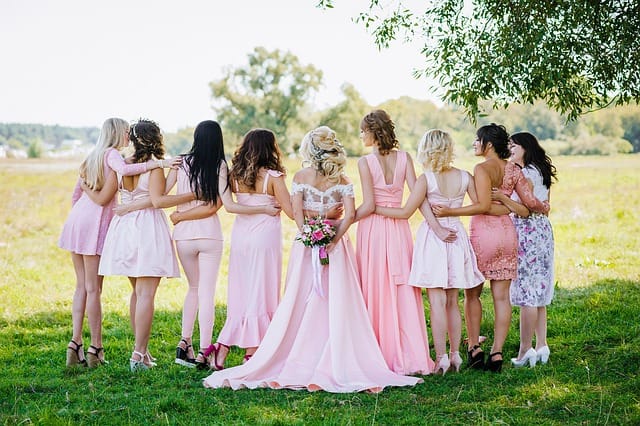
| Bridesmaids Only | Bride centered, bridesmaids angled slightly inward. |
| Groomsmen Only | Groom in front, groomsmen behind or beside, casual and confident poses. |
| Couple + Each Side | Bride + bridesmaids, Groom + groomsmen. |
| Couple + Maid of Honor/Best Man | Intimate, supportive pose. |
| Fun/Creative Shots | Jumping, walking, dancing, using props or themed setups. |
| Family Combinations (Optional) | Parents + couple + party for full legacy shot. |
Print this list or store it on your phone/tablet. Share it with your assistant or planner so they can help call people into position efficiently.
Tip: Start with large groups first (when everyone’s fresh and excited) and then move into smaller clusters. This helps maintain energy and saves time.
Final Checklist Before the Big Day
Before wrapping up your planning phase, ensure you’ve covered these essentials:
- ✅ Confirm schedule and contact numbers for planner and couple.
- ✅ Double-check weather forecast and backup locations.
- ✅ Test your gear and charge all batteries.
- ✅ Pack snacks and water (long shoots can drain energy fast).
- ✅ Review your shot list one final time.
Preparation transforms chaos into creativity. When the wedding day arrives, you’ll be ready to lead with calm confidence, ensuring that every photo session feels effortless and enjoyable for everyone involved.
Posing and Composition Tips for Wedding Party Photography
Even with perfect lighting and preparation, your wedding party photography will only shine if the posing and composition bring the images to life. A well-posed group photo is not just about everyone standing in a line — it’s about telling a story, showing relationships, and balancing aesthetics with emotion.
Below are expert wedding party photography tips on how to position, compose, and direct your subjects for stunning, natural-looking results.
Group Photo Posing Best Practices
Group poses are the cornerstone of wedding party photography. They require thoughtful arrangement, a good eye for spacing, and patience.
Here’s how to make group poses look balanced and natural:
1. Arrange by Height and Symmetry
- Place the couple in the center as the visual anchor.
- Flank them symmetrically with the wedding party — tallest members at the edges, medium height near the middle.
- Use staggered rows: some standing, some sitting, others leaning slightly to create depth and variation.
2. Use Triangular Composition
This classic composition principle draws the viewer’s eye naturally toward the couple. Arrange subjects so their heads form subtle triangles in the frame.
3. Encourage Connection
Ask everyone to lean slightly toward the couple or each other. Small gestures (a hand on a shoulder, shared laughter) help avoid stiff, disconnected poses.
4. Maintain Comfort
Keep sessions brief, especially in outdoor heat or long ceremonies. A relaxed group always looks better than a perfect but tired one.
📸 Pro Tip: Shoot multiple frames in quick bursts — someone always blinks or looks away. The best shot often comes from the in-between moments.
Candid and Action Shots Within the Party
While formal portraits are essential, candid wedding party photos capture the spirit of the celebration. These moments of laughter, joking, or quiet emotion bring authenticity that couples love.
Here’s how to get them right:
- Blend in: Move quietly, shoot from a distance with a zoom lens (70–200mm) so subjects forget you’re there.
- Prompt Interaction: Ask the bridesmaids to whisper something funny to the bride, or have the groomsmen share a toast. These small cues lead to genuine reactions.
- Capture Transitions: Some of the best candids happen between posed shots—like walking to the next spot or fixing outfits.
- Use Continuous Autofocus (AF-C): Keeps moving subjects sharp while allowing flexibility in composition.
“Candid wedding party photography isn’t about waiting for moments—it’s about creating the conditions where they naturally happen.” — Harper’s Wedding Journal, 2023
Creative and Themed Shots for the Wedding Party
Modern couples love creativity. Adding themed or fun photos to your wedding party photography gives variety and personality to the album.
Popular ideas include:
- The “Walk and Laugh” Shot – Ask the group to walk toward the camera naturally, chatting and laughing. Use a slightly wide lens for a cinematic effect.
- The “Cheers” Moment – Raise glasses or bouquets together in celebration. Works great at receptions or outdoors with good light.
- Themed Shots – Vintage cars, rustic barns, or color-coordinated props can reflect the couple’s personality.
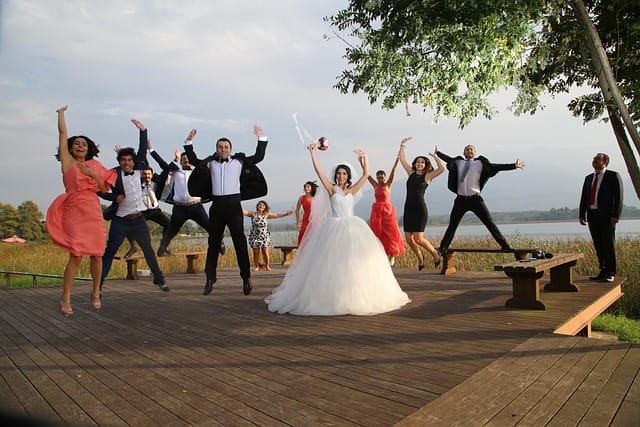
- The Lift or Jump Pose – Groomsmen lifting the groom or bridesmaids lifting the bride’s dress slightly for a playful touch.
- Reflections or Shadows – Use mirrors, puddles, or architectural glass for creative framing.
When doing themed photos, make sure they align with the couple’s aesthetic — timeless creativity beats trendy gimmicks every time.
Lighting Techniques for Wedding Party Photography
Lighting can make or break group photos. Because wedding parties are often large, even illumination is key. Let’s explore the most effective lighting approaches.
Outdoor Lighting Tips:
- Golden Hour Magic: Shoot early morning or late afternoon for warm, flattering tones.
- Avoid Harsh Noon Sun: If unavoidable, position the group with their backs to the sun and use a reflector or flash to fill shadows.
- Use Shade: Soft, diffused light under trees or awnings helps prevent squinting.
Indoor Lighting Tips:
- Bounce Flash: Point flash upward or sideways to reflect off ceilings/walls for softer results.
- Use Constant Lighting: LED panels or continuous lights help preview the effect in real-time.
- Mind the Color Temperature: Match artificial lights to your camera’s white balance to avoid orange or blue tints.
Night or Reception Shots:
- Off-Camera Flash: Position flashes behind or beside the group to create dramatic highlights.
- Ambient Light: Capture mood lighting from fairy lights, candles, or chandeliers — adjust ISO and shutter speed accordingly.
| Lighting Type | Best Use Case | Effect |
| Natural Light | Outdoor shots | Soft, warm tones |
| Bounce Flash | Indoor ceremonies | Balanced, flattering light |
| Reflectors | Outdoor group shots | Even fill, eliminates shadows |
| Off-Camera Flash | Night photos | Dramatic and cinematic look |
Pro Tip: Always take a few test shots to check for uneven light or shadows on faces—especially when the party spans a wide frame.
Example Case Study: Managing a Large Party
At a 2024 summer wedding in Austin, a photographer had to shoot a 22-member wedding party in the afternoon sun — harsh light and zero shade.
Here’s how they handled it:
- They placed the couple slightly elevated (on steps) for natural hierarchy.
- Used two reflectors on each side to balance sunlight.
- Staggered the rows (standing, sitting, crouching) for better depth.
- Shot in RAW for flexibility in post-processing color balance.
Result: a bright, cohesive photo with smiling faces and zero harsh shadows.
This demonstrates how composition, light, and structure work together to produce professional, magazine-worthy images even in difficult conditions.
Final Thoughts on Posing and Composition
The best wedding party photography tips emphasize balance — technical skill combined with emotional authenticity. Perfect alignment means little if the group looks bored or disconnected. Instead, focus on energy, relationships, and flow.
A relaxed, confident photographer sets the tone for everyone else. Smile, encourage, and engage — and your subjects will mirror that energy in every shot.
Timing and Workflow on the Wedding Day
When the wedding day finally arrives, preparation meets execution. This is where your planning, communication, and technical skills merge to deliver smooth, efficient, and stress-free photography sessions.
Time management during wedding party photography can make or break the experience — not just for you but also for the couple and their guests. A chaotic or disorganized workflow can lead to rushed, awkward shots and frustrated subjects. But with proper timing and coordination, you can create a seamless flow that keeps everyone happy and results in breathtaking photos.
Here’s how to manage your wedding day workflow like a seasoned pro.
Coordinating with the Wedding Party and Planner
The wedding party is a dynamic mix of personalities — excited bridesmaids, playful groomsmen, emotional parents, and occasionally a few camera-shy members. Keeping everyone synchronized requires clear communication and authority delivered with warmth.
Here’s how to do it:
- Establish a Point of Contact:
Work with the wedding planner or assign a “photo captain” from the bridal party (often the best man or maid of honor). This person helps gather people when it’s time for group shots. - Set Expectations Early:
During the morning prep or before the ceremony, remind everyone when and where group photos will happen. A short announcement saves valuable time later. - Use the Timeline Wisely:
Most photographers schedule 30–45 minutes for full wedding party photos. Break this into smaller blocks:
- 10–15 minutes for the full group
- 10 minutes for bridesmaids
- 10 minutes for groomsmen
- 5–10 minutes for couple + party creative shots
- 10–15 minutes for the full group
- Stay Positive and Engaged:
Keep energy high with humor and encouragement. People mirror your tone — if you’re calm and cheerful, the wedding party will be too.
Pro Tip: Use clear, friendly direction — “Let’s have everyone take one small step toward the couple,” sounds more natural than “Move closer!” Simple language builds cooperation.
Efficient Workflow: From Large Group to Smaller Groups
Efficiency is critical when juggling multiple combinations of people and poses. The best approach is to move from large to small groups systematically.
Step-by-step breakdown:
| Step | Group Type | Purpose |
| 1 | Entire wedding party | Showcase unity, excitement, and celebration |
| 2 | Bridesmaids + Bride | Highlights bond and elegance |
| 3 | Groomsmen + Groom | Adds character and camaraderie |
| 4 | Couple + Each Side | Balance and symmetry |
| 5 | Creative/Fun Group Shots | Capture energy and laughter |
| 6 | Individual Portraits (Optional) | Perfect for albums and social sharing |
As you move from one group to another, make transitions engaging. Compliment good poses, crack light jokes, or share a preview from your camera screen to keep morale up.
Speed Tips:
- Have your assistant or planner call the next group while you finish the current one.
- Use verbal cues like “Bridesmaids, you’re next!” so there’s no confusion.
- Keep your camera settings ready (same exposure, slight tweaks for composition).
📸 Pro Tip: For large parties, shoot a few quick “insurance shots” before adjusting poses. It guarantees at least one usable image even if someone blinks.
Managing Unexpected Delays and Changes
Weddings rarely run on schedule. Someone’s missing, weather changes, makeup takes longer — it’s normal. What sets a great photographer apart is adaptability.
Common challenges and how to handle them:
| Challenge | Quick Solution |
| Late or Missing Member | Start with available combinations and fill in later. Avoid idle time. |
| Bad Weather | Move indoors or under shade; use bounce flash or softbox for consistent lighting. |
| Time Crunch Before Reception | Focus on must-have shots first (couple + full party) and skip extras if necessary. |
| Low Energy Group | Play upbeat music, encourage laughter, and keep poses relaxed and fun. |
“Flexibility is a photographer’s hidden skill. The couple may forget the timeline, but they’ll remember how calm you stayed under pressure.” — Professional Photographers of America (PPA) 2023 Report
Remember — your calm confidence will help ease any tension. Even under pressure, maintain a professional demeanor and keep the session flowing smoothly.
Using Time Efficiently: Golden Moments vs. Rushed Shots
A wedding day moves fast, and light doesn’t wait. Pay attention to timing and use natural breaks to your advantage:
- Before the Ceremony: Great for relaxed bridal party portraits without guests around.
- After the Ceremony: Capture joy and adrenaline — ideal for candid moments.
- Golden Hour (Evening): Perfect for warm, cinematic light on outdoor shots.
Pro Tip Table:
| Time Slot | Lighting Quality | Best Photo Type |
| Morning (8–10 AM) | Soft, cool light | Bridal prep, detail shots |
| Noon (12–2 PM) | Harsh, direct light | Use shade or bounce flash |
| Late Afternoon (4–6 PM) | Warm, golden tones | Full wedding party group shots |
| Evening/Night | Ambient, moody | Reception and creative flash shots |
Always plan to shoot the largest group photos during the best light window. The warm tones and even exposure will elevate your entire collection.
Real-World Workflow Example
Here’s how a professional schedule might look for a 12:00 PM ceremony:
| Time | Task |
| 9:00–10:00 AM | Bride & bridesmaids prep photos |
| 10:00–10:45 AM | Groom & groomsmen portraits |
| 11:00–11:30 AM | Couple’s first look & reactions |
| 12:00–12:45 PM | Ceremony coverage |
| 1:00–1:30 PM | Full wedding party photos |
| 1:30–2:00 PM | Family + creative group photos |
| 2:00 PM onwards | Reception coverage & candids |
This structure keeps things flowing smoothly, ensures natural lighting for key shots, and builds in a small buffer for delays.
Final Thoughts on Wedding Day Workflow
The best wedding party photography tips go beyond camera settings — they focus on leadership, timing, and connection. A well-timed workflow allows you to capture both the elegance of formal portraits and the raw joy of spontaneous moments.
Your ultimate goal: make the process fun, fast, and flawless. When the wedding party enjoys the experience, their energy translates directly into radiant, genuine photos that couples will cherish for years.
Post-Processing and Delivery Tips for Wedding Party Photos
Capturing the perfect wedding party shots is only half the journey — the magic truly comes alive during post-processing. Editing is where you refine your photos, enhance mood and color, and create a cohesive storytelling style that represents your brand as a photographer.
Post-production is not just about “fixing” photos. It’s about polishing and perfecting them to evoke emotion and consistency. In this section, we’ll cover editing workflows, color grading, image curation, and delivery best practices that transform your wedding party gallery into an unforgettable visual narrative.
1. Organizing and Backing Up Your Files
Before diving into editing, it’s essential to establish a structured system to protect and manage your data. Many photographers have learned the hard way that disorganized or lost files can cost reputation and clients.
Follow this workflow for foolproof organization:
- Create Dual Backups Immediately:
Copy files to two separate drives (e.g., one SSD + one cloud service such as Dropbox or Google Drive).
Use a Consistent Folder Structure:
Example:
/Weddings/
/2025_James_Amanda/
/RAW/
/Edited/
/Highlights/
/Exports/
- Rename Files Consistently:
Use descriptive names for better management:
2025-07-14_JamesAmanda_BridalParty_001.CR2 - Cull Efficiently:
Use software like Photo Mechanic or Lightroom to quickly review and reject duplicates or missed shots. Focus on expressions, posture, and composition rather than perfection.
📊 Pro Insight: Top wedding photographers typically deliver 400–800 edited images for a full-day event, with 40–60 of those being wedding party photos.
2. Editing Workflow and Color Correction
Once your best shots are selected, it’s time to enhance their visual appeal. The goal is to create natural, timeless edits that highlight emotion without over-processing.
Recommended editing workflow:
| Step | Action | Tool Suggestion |
| 1 | Adjust White Balance | Lightroom (Temp & Tint sliders) |
| 2 | Correct Exposure & Contrast | Curves or Basic Panel |
| 3 | Refine Highlights & Shadows | Recover details in bright dresses and dark suits |
| 4 | Apply Lens Correction | Remove distortion/vignetting |
| 5 | Sharpen & Add Clarity | Use subtle sharpening for eyes and details |
| 6 | Apply Noise Reduction | Especially for low-light reception shots |
| 7 | Crop & Straighten | Maintain composition balance |
| 8 | Sync Edits Across Similar Shots | Save time for group photo series |
💡 Pro Tip: Avoid “over-smoothing” skin tones. Maintain texture for authenticity—brides and grooms appreciate photos that feel real.
3. Consistent Color Grading for Cohesive Storytelling
Every wedding has a unique color palette—pastel dresses, dark tuxedos, warm venues, or natural greens. Your edits should complement these tones while maintaining a consistent brand style.
Three proven styles for wedding party photography:
| Editing Style | Description | Ideal For |
| Light & Airy | Soft whites, bright highlights, pastel tones | Outdoor weddings, daytime ceremonies |
| Moody & Cinematic | Deep contrast, warm tones, artistic shadows | Indoor, rustic, or evening weddings |
| True-to-Life | Balanced tones, realistic skin color | Classic or timeless clients |
If you shoot multiple weddings, use Lightroom Presets or Capture One Styles to maintain uniformity across your portfolio.
🎨 “Your editing style is your signature. Couples book you for how your photos feel, not just how they look.”
4. Retouching Group Photos
Group photos, especially of large wedding parties, often require additional fine-tuning. You’re dealing with multiple faces, expressions, and outfits — so precision matters.
Essential retouching steps:
- Remove temporary blemishes or flyaway hairs.
- Adjust color inconsistencies in skin tones (especially when mixing indoor/outdoor light).
- Brighten eyes and teeth subtly to make expressions pop.
- Use cloning tools to fix distractions in the background (like poles, clutter, or guests).
- Correct posture distortions caused by wide-angle lenses.
🧠 Pro Tip: Use Photoshop’s Auto-Blend Layers when merging multiple shots to ensure everyone’s eyes are open and smiles are perfect.
5. Exporting and Delivering Final Photos
After editing, your next task is to export and deliver the final images in a way that’s professional, accessible, and delightful for the client.
Best practices for export:
- Resolution: 300 DPI for print, 72 DPI for web/social media.
- Format: JPEG (sRGB color space for universal compatibility).
- File Size: 2–5 MB per image for online delivery; full-resolution copies for albums.
- Watermark: Optional for sneak peeks or previews only.
Delivery methods:
| Method | Pros | Recommended For |
| Online Gallery (Pixieset, Pic-Time) | Elegant, easy sharing, download control | Most photographers |
| USB Drive | Tangible keepsake | Luxury packages |
| Cloud Folder (Google Drive, Dropbox) | Simple and fast | Budget-friendly packages |
🎁 Bonus Idea: Create a custom “wedding day slideshow” with 30–50 of the best moments. Couples love sharing these on social media or at post-wedding events.
6. Archiving and Client Follow-Up
Finally, once the gallery is delivered, archive your files and follow up with your clients.
Archiving Tips:
- Keep backups for at least 12 months.
- Use external SSDs or RAID storage for long-term protection.
- Save a secondary copy to cloud storage (Amazon S3, Backblaze, or Google One).
Follow-Up Strategy:
- Send a thank-you email and encourage clients to share reviews.
- Offer referral discounts for future sessions.
- Ask for permission to feature select wedding party shots on your portfolio or social media.
⭐ A smooth delivery and follow-up process strengthens your reputation and generates repeat business.
Final Thoughts on Post-Processing
Post-production is the bridge between a good wedding photo and a great one. It’s where your artistic vision takes shape and your technical precision shines. By maintaining consistency, attention to detail, and storytelling flow, you’ll elevate every wedding party collection into a cohesive masterpiece.
Mastering these wedding party photography tips for editing and delivery not only enhances your photos but also reinforces your professionalism — ensuring every couple receives images they’ll cherish for a lifetime.
Common Mistakes to Avoid in Wedding Party Photography
Even the most experienced photographers can slip up during wedding shoots. With so many moving parts—timing, lighting, people, and emotions—mistakes can happen fast. However, knowing what to avoid ahead of time can save your workflow, your reputation, and even your client relationships.
Below are the most common wedding party photography mistakes and actionable tips to prevent them. These insights come directly from seasoned professionals and industry studies, making them essential for every photographer looking to perfect their craft.
1. Poor Planning and Lack of Coordination
The number one mistake photographers make is showing up unprepared or assuming things will “just fall into place.”
A wedding day is a live event—there are no retakes.
Avoid this mistake by:
- Creating a detailed shot list before the wedding (with backup options for weather or venue changes).
- Coordinating with the planner, couple, and bridal party about the timeline.
- Visiting the venue in advance to test lighting and find ideal backdrops.
💡 Pro Tip: A well-planned photo schedule saves you at least 30 minutes on the wedding day and reduces stress for everyone involved.
2. Overcrowded or Unbalanced Group Poses
When photographing large groups, many beginners focus only on getting everyone in the frame. But balance, symmetry, and spacing are just as important as inclusion.
Common pose mistakes:
- Uneven height levels (tall people in front or awkwardly placed).
- Cluttered arrangement with no visual flow.
- Random hand or arm positions that look unnatural.
Fix it like a pro:
- Use stairs, benches, or risers to create layered height levels.
- Have taller individuals on the sides or back row.
- Give clear, friendly instructions: “Everyone angle your shoulders slightly toward the center.”
- Check edges of the frame for cropped hands or missing feet.
📸 Remember: Composition mistakes are harder to fix in post-production than on set.
3. Ignoring Lighting Conditions
Lighting can make or break your photos. Relying solely on natural light or forgetting to adapt to harsh or dim conditions is one of the biggest beginner errors.
Avoid lighting issues by:
- Carrying reflectors or a portable flash for fill light during midday shoots.
- Shooting group photos in open shade to avoid harsh shadows.
- Using the golden hour (around sunset) for the most flattering tones.
- Checking your histogram often to avoid overexposure in white dresses.
Expert Insight: According to a 2024 PPA study, lighting inconsistencies are the most common reason clients request re-edits.
4. Not Capturing Genuine Emotions
A technically perfect photo means nothing if it lacks soul.
One of the biggest wedding photography mistakes is failing to capture authentic, candid moments.
Avoid stiff, lifeless photos by:
- Encouraging natural interaction: tell the groomsmen to share a joke or have the bridesmaids cheer the bride.
- Giving prompts, not poses. Example: “Walk toward me like you’re on a runway,” instead of “Stand here and smile.”
- Being invisible when possible—use a zoom lens to capture unposed laughter and tears.
🎯 Pro Tip: Genuine emotion creates connection. Couples cherish those raw, unscripted memories far more than formal portraits.
5. Forgetting to Check Small Details
The camera captures everything—including mistakes. Missing small details like wrinkled dresses, crooked ties, or stray hair can ruin an otherwise beautiful shot.
Be proactive:
- Do a quick visual scan before each photo.
- Keep a small “photo emergency kit” with safety pins, lint rollers, tissues, and hairpins.
- Ask a bridesmaid or assistant to help tidy up the group before you shoot.
🧵 Case Study: A popular wedding photographer once lost a client’s referral because several photos had lipstick stains on the groom’s collar—something easily fixable if spotted early.
6. Rushing Through the Session
When under time pressure, many photographers speed through poses, skipping creative shots or forgetting to vary compositions. The result: a gallery that feels repetitive and uninspired.
Avoid this by:
- Creating a rhythm: alternate between full group, close-up, and candid shots.
- Taking 2–3 quick photos per pose to ensure you have a perfect version.
- Using verbal cues to keep energy up while maintaining flow.
⏱️ Time management isn’t about shooting faster—it’s about shooting smarter.
7. Neglecting Communication and Energy
The mood of the photographer often sets the tone for the group. If you’re stressed or disengaged, the party will reflect that energy in the photos.
Stay connected by:
- Being personable—learn a few names from the wedding party early on.
- Using humor or light direction to keep spirits high.
- Always giving positive feedback: “That’s great!” “Perfect angle!” “You look fantastic!”
A confident, friendly photographer not only gets better photos but also better reviews and referrals.
8. Failing to Capture Variations
Many photographers focus too heavily on standard posed shots and forget creative variations that make an album shine.
Avoid monotony by including:
- Action shots: walking, jumping, clinking glasses.
- Candid interactions: laughter, tears, inside jokes.
- Environmental portraits: use venue architecture or nature as background.
- Detail shots: bouquets, shoes, cufflinks, champagne glasses.
These photos tell the complete story of the wedding day and are often the couple’s favorites.
9. Skipping Backup Plans for Gear
Technical issues are inevitable—batteries die, memory cards corrupt, lenses fog up. Not preparing for this is one of the most avoidable mistakes in wedding photography.
Always carry:
- Two camera bodies
- Extra memory cards
- Spare batteries
- A backup flash
- Weather protection (umbrellas, covers)
🔋 Pro Tip: Fully charge everything the night before, and label your memory cards to avoid overwriting files.
10. Delivering Photos Too Slowly
Couples are eager to relive their special day. Delaying delivery can damage trust and reduce referrals.
Fix this by:
- Sending a few sneak peek photos within 48 hours.
- Delivering the full gallery within 4–6 weeks (faster if possible).
- Communicating updates clearly if you experience delays.
According to The Knot’s 2024 Photography Report, couples ranked fast turnaround as one of the top 3 factors influencing satisfaction.
Final Thoughts on Avoiding Mistakes
Perfection in wedding party photography isn’t about never making mistakes—it’s about learning to anticipate, adapt, and recover quickly. By avoiding these pitfalls and applying the best wedding party photography tips, you’ll gain confidence, efficiency, and credibility as a professional.
Every wedding is different, but these lessons remain universal: plan ahead, engage authentically, pay attention to detail, and stay calm no matter what happens. Those habits separate the good photographers from the truly great ones.
Creative Ideas and Inspiration for Wedding Party Photography
Wedding party photography isn’t just about traditional group shots and posed smiles — it’s about telling a story.
The best photographers blend artistry, spontaneity, and emotion to create unforgettable images that feel alive.
In this section, we’ll explore fresh, creative ideas and techniques to inspire your next shoot. These wedding party photography tips go beyond the basics and help you create a gallery that reflects both your artistic eye and the couple’s unique personality.
1. Capture Movement and Interaction
Static poses can feel stiff and repetitive. Adding motion and interaction brings photos to life, helping to express the joyful energy of the day.
Creative ways to add movement:
- Have the wedding party walk toward the camera, holding hands or laughing.
- Ask the groomsmen to lift the groom or the bridesmaids to cheer the bride.
- Use the couple as a focal point while the party circles around them playfully.
- Have everyone toss flower petals or confetti for a natural burst of excitement.
🎬 Pro Tip: Use a fast shutter speed (1/500 or higher) to freeze motion and keep expressions crisp.
2. Embrace Themed or Styled Shots
Every wedding has its own theme — rustic, boho, classic, modern, or beachside.
Incorporating these elements into your wedding party shots creates cohesive, storytelling images.
Examples:
- Rustic Weddings: Pose the party in front of barns, vintage trucks, or hay bales.
- Beach Weddings: Capture barefoot shots with waves in the background.
- Luxury Weddings: Use elegant architecture, staircases, or chandeliers for symmetry.
- Garden Weddings: Play with natural arches, floral backdrops, or soft bokeh through trees.
💡 Pro Tip: Always scout the venue for hidden gems — staircases, textured walls, or reflection surfaces can become your best props.
3. Play with Perspective and Composition
Unique perspectives can turn ordinary group shots into dynamic, magazine-worthy photos.
Try these composition ideas:
- Bird’s-eye view: Stand on a balcony or ladder to capture everyone looking up.
- Low angle: Make the group appear powerful and cinematic.
- Wide lens storytelling: Capture the entire setting — perfect for outdoor weddings.
- Symmetry and reflections: Use mirrors, water puddles, or glass windows creatively.
📸 Example Setup:
For a 12-person party, arrange the group in a semi-circle with the couple in the center. Then, shoot slightly off-center for a natural, balanced look.
4. Incorporate Fun and Personality
Couples and wedding parties love photos that reflect their fun side.
Encourage playful, candid moments instead of forcing smiles.
Fun photo ideas:
- Jump shots with coordinated timing.
- Signature pose series: Let each person strike a silly or dramatic pose.
- Reaction shot: Have the wedding party react dramatically to the couple’s kiss.
- Toast photo: Everyone raises glasses toward the couple in celebration.
💬 Quote: “Laughter and spontaneity are the most powerful tools in a wedding photographer’s kit.” — Marta Koch, Wedding Photographer of the Year 2023
5. Create Storytelling Sequences
Think of your wedding party photos as part of a visual narrative, not just individual snapshots. Storytelling makes galleries more engaging and emotionally resonant.
Storytelling flow examples:
- Preparation: Bridesmaids helping the bride with her veil or jewelry.
- Arrival: The party walking together toward the ceremony.
- Celebration: Group cheers right after “I do.”
- Transition: The party leaving the ceremony or entering the reception.
- Evening Joy: Dance floor laughter and champagne toasts.
By capturing these scenes in sequence, you create a cinematic album that flows naturally from start to finish.
6. Use Creative Lighting Techniques
Lighting can be your most powerful artistic tool when used intentionally.
Lighting ideas to try:
- Backlighting: Place the sun or a flash behind the party for glowing outlines.
- Golden Hour: Capture soft, warm light right before sunset for dreamy tones.
- Nighttime Sparklers: Create magical, glowing group shots with sparklers or string lights.
- Artificial Light Drama: Use off-camera flash or gels for high-contrast evening portraits.
📊 Lighting Fact:
According to WPPI 2024 Trends Report, photos taken during golden hour receive 42% more engagement on social media than those shot in midday light.
7. Highlight the Relationships
The heart of wedding party photography lies in relationships — friendships, laughter, and shared memories.
Go beyond standard group shots to capture genuine connection.
Ideas to bring relationships forward:
- Best friends sharing a secret or joke.
- Parents adjusting a tie or hugging their child.
- Bridesmaids holding hands or sharing a tear during the vows.
- Groomsmen clinking glasses before the ceremony.
These moments humanize your photos and add emotional depth to the final album.
8. Include the Venue as a Character
The venue isn’t just a backdrop — it’s part of the couple’s story.
Frame your shots to showcase architectural details, landscapes, or décor that define the wedding’s character.
Examples:
- Use arches, doors, or chandeliers to frame the group.
- Capture wide landscape shots showing the setting sun behind the venue.
- Incorporate floral arrangements, candles, or décor elements subtly in the foreground for added depth.
🌆 Creative Tip: Include one “epic wide shot” of the full wedding party with the venue behind — it often becomes the couple’s favorite print.
9. Experiment with Black & White Edits
Black and white wedding photos convey emotion and timelessness like nothing else.
Convert select wedding party images into monochrome to draw attention to expression and contrast.
Best moments for black & white:
- Laughter-filled group hugs.
- Emotional toasts.
- First look reactions.
- Dance floor candids.
🖤 Pro Tip: Use black & white selectively — too many can make the gallery feel repetitive. Aim for 10–15% of your final wedding party collection.
10. Candid “In-Between” Moments
Some of the most powerful images happen when no one’s posing.
Keep your camera ready between formal shots to catch authentic interactions—the laughter, chaos, and love that define the day.
Examples:
- Bridesmaids fixing makeup or sharing snacks.
- Groomsmen joking before lining up for photos.
- Kids dancing or running around the group.
- A quiet look between the couple while others cheer.
🎯 Remember: These “in-between” shots often become the emotional core of a wedding album.
Final Thoughts on Creative Wedding Party Photography
True creativity in wedding party photography isn’t about using gimmicks—it’s about being observant, spontaneous, and authentic.
When you combine technical precision with artistic storytelling, your work becomes more than just photos—it becomes legacy imagery.
By incorporating these creative wedding party photography tips, you’ll elevate your portfolio, delight your clients, and set yourself apart in a highly competitive industry.
Frequently Asked Questions (FAQs) About Wedding Party Photography
Every couple — and even many photographers — have questions about how to make the most of wedding party photography. From managing large groups to posing naturally, these FAQs cover the most common concerns with practical, experience-based answers.
Whether you’re a beginner photographer looking to refine your craft or a couple planning your big day, these answers will help ensure your wedding party photos turn out beautifully.
1. What is the ideal time to take wedding party photos?
The best time for wedding party photos depends on your lighting conditions and schedule.
- Before the ceremony: Great for “first look” sessions and relaxed portraits without guests waiting.
- After the ceremony: Ideal for candid joy and celebration shots.
- Golden hour (just before sunset): Offers soft, warm, and flattering light perfect for group photos.
📸 Pro Tip: Plan 30–45 minutes for wedding party photos, and ensure it aligns with your lighting conditions for the best results.
2. How many photos should I deliver from the wedding party session?

Most photographers deliver between 40 and 60 edited photos dedicated to the wedding party, depending on the size and complexity of the group.
These typically include:
- Full wedding party shots
- Bridesmaids and groomsmen groups
- Couple with each side
- Creative and candid moments
Quality over quantity. A few stunning, well-edited shots have far more value than hundreds of repetitive images.
3. What camera settings are best for wedding party photography?
Settings depend on the environment, but these general wedding party photography tips work well in most conditions:
| Scenario | Aperture | Shutter Speed | ISO |
| Outdoor (Daylight) | f/4 – f/5.6 | 1/250 – 1/500 | 100 – 400 |
| Indoor (Low Light) | f/2.8 – f/4 | 1/125 | 800 – 1600 |
| Flash/Artificial Light | f/4 – f/5.6 | 1/160 | 400 – 800 |
💡 Tip: Keep your aperture around f/4 or higher when photographing large groups to maintain focus across all faces.
4. How do you pose a large wedding party effectively?
Posing a big group can be tricky, but structure and communication are key.
Steps for perfect posing:
- Start with the couple in the center.
- Add bridesmaids and groomsmen symmetrically on both sides.
- Vary height by using stairs, benches, or uneven terrain.
- Ask everyone to slightly angle their bodies toward the center.
- Finish with candid variations — laughter, movement, and personality.
“Great group posing is about energy, not symmetry. Keep it natural, not robotic.”
5. What should the photographer focus on — candid or posed shots?
Both! A strong wedding party album combines posed portraits for tradition and candid moments for authenticity.
- Posed shots are timeless and ideal for prints and albums.
- Candid shots capture laughter, emotion, and personality.
Use prompts like “laugh together” or “walk toward me like you’re celebrating” to blend both naturally.
6. How do you deal with camera-shy wedding party members?
Not everyone feels comfortable in front of a camera, and that’s okay. The key is to build rapport and reduce pressure.
Try these tips:
- Crack light jokes or play fun background music.
- Give them small, easy actions instead of stiff poses.
- Use longer focal lengths (85mm–135mm) to capture from a distance.
- Show them a few preview shots to boost confidence.
🎯 Remember: Confidence grows when people feel seen, not scrutinized.
7. What are some must-have wedding party shots?
Here’s a list of must-have photos every wedding party album should include:
| Category | Description |
| Full Group Portrait | The entire wedding party together (formal + fun versions) |
| Bridesmaids + Bride | Both posed and candid variations |
| Groomsmen + Groom | Group and individual portraits |
| Couple + Each Side | Balanced, symmetrical compositions |
| Candid Moments | Laughter, cheering, walking, hugging |
| Creative Shots | Reflections, silhouettes, jumping, dancing |
| Venue Wide Shot | Party in front of venue or landscape backdrop |
💍 Bonus: Include one black-and-white edit — timeless and emotional.
8. What’s the best way to manage time on a busy wedding day?
Use a wedding photo timeline and coordinate closely with the planner.
Example structure for smooth workflow:
| Time | Activity |
| 9:00 AM | Bridal prep + details |
| 10:30 AM | Groom prep |
| 11:30 AM | First look + couple portraits |
| 12:00 PM | Ceremony |
| 1:00 PM | Wedding party photos |
| 2:00 PM | Family portraits |
| 4:00 PM | Reception + candids |
🕒 Always build in 15-minute buffers for unexpected delays.
9. How can I make my wedding party photos stand out from others?
Creativity and authenticity are your biggest differentiators.
Apply these advanced wedding party photography tips to elevate your style:
- Use unique angles (low or aerial).
- Experiment with golden hour or backlighting.
- Encourage natural laughter instead of static smiles.
- Incorporate venue architecture or décor into the frame.
- Add motion — walking, dancing, or champagne sprays.
Be an artist, not just a documentarian.
10. How soon should I deliver the photos to clients?
The standard delivery window is 4–6 weeks, but couples love quick previews.
Best practice:
- Send 5–10 sneak peeks within 48 hours.
- Deliver the final gallery within the agreed timeline.
- Offer both high-resolution (for print) and web-sized (for social media) versions.
Fast, organized delivery builds trust and encourages word-of-mouth referrals.
11. What gear do I need for wedding party photography?
Here’s a quick breakdown of recommended gear:
| Equipment | Purpose |
| Full-frame DSLR or Mirrorless Camera | Better low-light performance |
| 24–70mm Lens | Versatile for group and close-up shots |
| 70–200mm Lens | Great for candid distance portraits |
| External Flash or Reflector | Control light in varying conditions |
| Backup Camera & Batteries | Essential for reliability |
| Tripod or Monopod | Stability for formal group shots |
Bonus Tip: Always bring lens wipes, extra SD cards, and a rain cover—just in case!
12. What editing style works best for wedding party photos?
It depends on the couple’s personality and wedding theme. Popular styles include:
- Light & Airy: Soft tones, bright whites — perfect for outdoor weddings.
- Moody & Cinematic: Deep shadows, warm highlights — ideal for rustic venues.
- True-to-Life: Balanced, timeless, realistic tones — fits any event.
Whatever you choose, keep your editing consistent throughout the gallery.
Final Thoughts on Wedding Party Photography FAQs
Mastering wedding party photography requires both technical precision and emotional awareness.
Every question above circles back to one principle: be prepared, be creative, and stay connected.
When you apply these wedding party photography tips, you’ll capture images that don’t just document a day—they preserve memories, emotions, and personalities that couples will treasure for a lifetime.
Conclusion & Key Takeaways on Wedding Party Photography Tips
Wedding party photography is both an art and a science. It goes beyond group shots — it’s about capturing the energy, connection, and joy that surround the couple on their most important day. Whether you’re a professional photographer or a couple planning your dream wedding, understanding these wedding party photography tips can make the difference between ordinary images and unforgettable memories.
Key Takeaways to Remember
Let’s summarize the most essential lessons from this comprehensive guide:
| Category | Key Insights |
| Preparation | Plan every detail ahead — from scouting the venue to creating a detailed shot list. Communication is everything. |
| Lighting | Use natural light whenever possible. Golden hour is unbeatable for warm, glowing tones. |
| Composition | Keep balance, symmetry, and storytelling in mind. Include candid, posed, and creative angles. |
| Posing | Direct with confidence but keep it fun. Encourage movement and genuine expressions. |
| Gear & Settings | Use versatile lenses (24–70mm, 70–200mm). Keep aperture around f/4–f/5.6 for large groups. |
| Time Management | Schedule 30–45 minutes for party photos and allow buffer time for delays. |
| Editing | Maintain a consistent color grade and enhance emotion without over-editing. |
| Mindset | Stay calm, positive, and flexible — your attitude sets the tone for everyone else. |
Why Wedding Party Photography Deserves Special Focus
Unlike couple portraits, wedding party photos bring together laughter, friendship, and the shared journey that led to this moment. They’re often the pictures that hang on walls, get framed as gifts, and are posted across social media for years to come.
In fact, according to a 2024 survey by The Knot, 8 out of 10 couples said their favorite photos were group candids of their friends and wedding party. This highlights that what people value most isn’t perfection — it’s authentic emotion.
“A wedding day may last just hours, but great photography turns it into a lifetime of memories.”
— Unknown Wedding Photographer
Pro Photographer Insight
Experienced photographers agree that success in wedding party photography comes from mastering two things: organization and empathy. You need to manage the logistics of a dozen or more people while also understanding how to bring out their personalities.
When everyone feels comfortable, the joy becomes contagious — and that’s when you capture the real magic.
Your Next Steps
If you’re a wedding photographer, start by:
- Creating a detailed wedding party photo checklist.
- Practicing group posing and lighting setups.
- Building a portfolio section dedicated to wedding parties.
If you’re a couple planning your big day, help your photographer succeed by:
- Providing a clear timeline and list of key people.
- Allowing enough time for group photos.
- Encouraging your party to relax and have fun in front of the camera.
Final Word
Great wedding party photography isn’t about snapping pictures — it’s about telling stories.
Every glance, laugh, and embrace carries meaning. By applying these wedding party photography tips, you’ll ensure that every image feels as genuine and vibrant as the memories themselves.
So whether you’re behind the lens or in front of it — take the time to prepare, connect, and create. The result will be more than just photos; it will be a visual legacy of love and friendship that lasts forever.