



There’s something truly magical about sunset beach family photos — the way the golden light dances on the waves, how the sky turns into a masterpiece of oranges, pinks, and purples, and the peaceful warmth that wraps around your loved ones. These moments are fleeting, but when captured the right way, they become timeless memories — glowing reminders of family connection and love.
Whether you’re planning a professional photo session or taking the DIY route, knowing how to use the sunset’s natural beauty can make all the difference. The beach already provides one of the most picturesque backdrops on earth — but pair it with the golden hour, and you’ve got a scene straight out of a dream.
In this comprehensive guide, we’ll explore every aspect of sunset beach family photography — from the perfect timing and lighting techniques to outfit choices, posing ideas, camera settings, and even how to keep your little ones smiling through it all. You’ll also discover real-life case studies, practical tables for outfit coordination, and expert tips from photographers who specialize in golden hour beach portraits.
What You’ll Learn in This Guide
- Why sunset is the best time for family beach photos.
- How to find the perfect beach location for golden hour photography.
- What to wear for sunset beach family photos (with color coordination table).
- Camera settings and lighting techniques for soft, radiant portraits.
- Family posing ideas and candid photo inspiration.
- Professional vs DIY beach photography — which is right for you.
- How to display, share, and preserve your sunset beach memories.
“The golden hour isn’t just about lighting — it’s about emotion. The glow of sunset adds warmth not just to your photos, but to your memories.”
— Lena Harper, Lifestyle Photographer, California
This guide is written to help you plan, capture, and cherish your family’s beach photo session with confidence — whether you’re standing on the sands of California, the shores of Florida, or the coasts of Australia.
Now, let’s begin by understanding why sunset truly is the best time for beach family photography and what makes it so enchanting for families worldwide.
Why Choose Sunset for Beach Family Photos?
There’s a reason photographers across the world swear by sunset beach family photos — it’s not just about timing, it’s about atmosphere. The sunset hour, often referred to as the golden hour, transforms the ordinary into the extraordinary. The light is soft, shadows are gentle, and every detail — from skin tones to waves — glows with a warm radiance that’s impossible to replicate at any other time of day.
When you capture your family against the backdrop of a setting sun, you’re not just freezing a moment in time — you’re telling a story of warmth, connection, and tranquility.
1. The Magic of Golden Hour Lighting
The period roughly one hour before sunset is when the sun is low on the horizon, filtering its light through more of Earth’s atmosphere. This natural diffusion creates a soft, golden hue that’s flattering for all skin tones and eliminates the harsh contrast that midday light produces.
- Soft Shadows: The light wraps gently around faces, minimizing dark under-eye shadows or squints.
- Warm Tones: The golden hue flatters skin and gives photos an inviting warmth.
- Balanced Exposure: You can easily capture both the sky’s color and your family’s expressions without overexposing one or the other.
📊 Lighting Comparison: Midday vs. Sunset Photos
| Feature | Midday Sun | Golden Hour Sunset |
| Light Quality | Harsh, direct, causes shadows | Soft, warm, evenly diffused |
| Temperature | Bright white/blue | Golden, amber |
| Shadows | Strong and defined | Gentle, flattering |
| Mood | Energetic, bright | Calm, romantic, emotional |
| Comfort Level | Hot, often causes squinting | Cool, relaxing |
As the chart shows, golden hour is ideal not only for technical reasons but also for the emotional tone it sets in your photos.
2. Emotional Warmth and Natural Connection
Sunset has an almost cinematic effect — it inspires calmness and intimacy. Families tend to feel more relaxed as the day winds down, and that translates beautifully on camera. The children are often calmer, parents are more present, and there’s a serene mood that no studio lighting can reproduce.
Photographers often describe golden hour family sessions as “effortlessly emotional” because the lighting encourages natural smiles, laughter, and tender moments. The subtle glow on your family’s faces, the breeze in the hair, and the gentle waves all come together to create photos that feel alive and genuine.
3. Perfect for Storytelling Photography
In photography, storytelling is everything. And the sunset’s gradual change in light — from golden to orange to soft pink — gives your photos a natural narrative arc. You can start with bright, energetic shots and end with silhouettes or quiet embraces as the sun dips below the horizon.
Example photo sequence for storytelling:
- Golden Moments: Family walking hand-in-hand on the shore.
- Playful Glow: Kids running through the shallow waves.
- Serene Embrace: Parents sitting together as the sky turns peach.
- Silhouette Finale: Family watching the last rays of sunlight.
This approach allows your sunset beach family photos to flow like a short film — full of energy, love, and emotion.
4. The Science Behind Sunset’s Golden Glow
Sunset lighting looks so magical because of a natural process called Rayleigh scattering — when sunlight travels through more of Earth’s atmosphere, shorter wavelengths (blue and violet) scatter, leaving longer wavelengths (red, orange, yellow) to dominate the sky.
So while the science is simple, the visual impact is stunning:
- Warm hues make photos more flattering and emotional.
- Sky gradients add natural color contrast without needing filters.
- Reflective water surfaces double the beauty by mirroring the colors of the sky.
5. A Calmer, Happier Environment for Families
Unlike the midday rush, sunset offers a peaceful, comfortable environment. The temperature cools, the beach crowds thin out, and your family can move freely without distractions. This makes kids more cooperative and adults less self-conscious — ideal conditions for genuine smiles and spontaneous laughter.
“Every time I photograph families at sunset, the vibe is completely different. The calm, the laughter, the color — it’s like nature itself becomes your studio.”
— Maya Torres, Family Photographer, Hawaii
Key Takeaways
- Sunset beach family photos are about more than light — they’re about emotion.
- The golden hour provides naturally flattering, warm tones that elevate your portraits.
- It’s the best time to capture real, unscripted moments of joy and connection.
- Scientifically, sunset light enhances the scene’s warmth and depth, creating photos that are both technically and emotionally beautiful.
Best Time for Sunset Beach Family Photos
Timing can make or break your sunset beach family photos. Even a 10-minute difference can completely change the lighting, color tones, and mood of your pictures. Capturing the perfect glow is all about knowing when to start shooting and how long the golden hour truly lasts.
Understanding the timing not only ensures beautifully lit portraits but also helps your family stay relaxed and prepared — especially if you have little ones who tire quickly. Let’s break down the science and strategy behind choosing the perfect time for your beach photoshoot.
1. Understanding the Golden Hour
The golden hour is the period shortly after sunrise or before sunset when the sunlight is softer, warmer, and more diffused. For most locations, this window lasts about 45–60 minutes before sunset, but the exact duration can vary based on your latitude, season, and weather conditions.
During this magical window:
- The sun’s low angle casts long, gentle shadows that add depth and texture.
- The light’s temperature shifts from harsh white to warm amber tones.
- You can photograph both the landscape and your family without harsh exposure contrasts.
📘 Pro Tip: You can find your exact golden hour by using tools like The Photographer’s Ephemeris, Time and Date, or Golden Hour Calculator — these apps help you track the sunset time for your exact beach location.
2. How to Calculate the Perfect Shooting Time
To get the best results, you should arrive and begin your shoot at least 60–90 minutes before the official sunset time.
Here’s why:
- The first 30 minutes before sunset provide the most balanced light.
- The last 15 minutes before the sun dips below the horizon create dramatic tones for silhouettes.
- After sunset, you get about 10 minutes of blue hour — a soft, cool light ideal for serene, moody portraits.
📊 Typical Sunset Photography Timeline
| Time Before Sunset | Light Quality | Ideal Shots |
| 60–45 min | Bright golden tones | Walking, playful shots |
| 45–20 min | Balanced warmth | Group portraits, close-ups |
| 20–5 min | Soft orange-pink glow | Silhouettes, emotional moments |
| 5 min–After Sunset | Blue hour light | Calm, dreamy portraits |
3. Seasonal Differences in Sunset Timing
Depending on the season, the golden hour can shift drastically. In summer, sunsets are late, giving you more flexibility; in winter, they can happen as early as 5 p.m., requiring better planning — especially for families with young children.
🌅 Average Sunset Times by Season (for Coastal Locations)
| Season | Average Sunset Time | Temperature | Best Tip |
| Spring | 6:30–7:30 PM | Mild | Arrive 1 hour early for best light |
| Summer | 7:30–8:30 PM | Warm | Bring water & sun protection |
| Fall | 6:00–6:45 PM | Cool | Layer clothing for comfort |
| Winter | 4:45–5:45 PM | Cool | Schedule early afternoon prep |
4. Weather and Sky Conditions to Watch For
Cloud cover can transform your sunset beach family photos from ordinary to breathtaking. Partial clouds often enhance the color palette of sunsets by reflecting light across the sky. However, full overcast days can mute the vibrancy.
Here’s how different skies affect your photos:
| Sky Condition | Light Effect | Resulting Mood |
| Clear Sky | Strong golden hues | Bright, vibrant, crisp |
| Partly Cloudy | Diffused light & colorful reflections | Romantic, soft glow |
| Overcast | Flat light, muted tones | Dreamy, calm, subtle warmth |
| Post-Rain | Enhanced clarity, reflective sand | Dramatic and striking |
“Some of my best sunset photos happened after rain — the wet sand reflects the sky, turning every shot into a mirror of color.”
— Daniel Cruz, Beach Photographer, Portugal
5. Factors That Can Affect Sunset Timing
Keep in mind that not all beaches face west, and the direction of the coastline affects how you’ll see the sunset. A west-facing beach gives you a direct view of the sun dipping below the horizon, while east-facing beaches capture softer pastel colors reflected in the sky.
Additional factors to consider:
- Tides: Check tide schedules to avoid high tide covering your favorite photo spots.
- Location Elevation: Cliffs or dunes may block or delay visible sunset light.
- Crowds: Early evening hours tend to attract tourists — arrive early to secure your space.
6. Case Study: Timing Success Story
Case Study: The Johnson Family, Laguna Beach, California
The Johnsons scheduled their photo session for 7:15 PM, 45 minutes before sunset. Their photographer started with playful shots of the kids in the water, transitioned into close family hugs as the sky turned orange, and finished with breathtaking silhouettes.
The result? A varied album of golden, pink, and blue hues, showcasing not only the family’s warmth but also the beauty of precise timing. Their experience highlights one major takeaway: planning around the golden hour creates consistency and emotional depth across the entire photo series.
Key Takeaways
- The best time for sunset beach family photos is 45–60 minutes before the sun sets.
- Use seasonal sunset calculators for accuracy.
- Pay attention to weather, tides, and direction for optimal lighting.
- Arrive early — preparation allows for more relaxed, natural moments.
Choosing the Perfect Beach Location for Sunset Family Photos
Choosing the right beach is just as important as picking the right time. The perfect location can turn your sunset beach family photos from ordinary snapshots into cinematic portraits full of life, warmth, and character. From calm coves with soft sand to rugged coastlines framed by cliffs and palm trees, your beach choice sets the tone for the entire photoshoot.
Let’s explore what makes a beach ideal for family portraits and how to find the perfect backdrop for your family’s story.
1. What to Look for in a Great Beach Photo Spot
The best beaches for family photography balance beauty, safety, and accessibility. It’s not only about the ocean view — it’s about how the light interacts with the landscape and how comfortable your family feels while shooting.
Here are key elements to consider:
- West-Facing View: For true golden sunsets, pick a west-facing beach. This ensures the sun sets directly over the water, giving you that breathtaking sky-to-sea gradient.
- Clean and Open Space: Avoid beaches cluttered with debris, seaweed, or large crowds. Smooth sand and clear horizons make for cleaner compositions.
- Natural Variety: Beaches with rocks, dunes, grasses, or boardwalks give you diverse backdrops within the same shoot — perfect for variety in your album.
- Accessibility: Especially with kids or grandparents, make sure your location is easy to walk to and has nearby parking or rest areas.
- Safety: Shallow water zones and gentle waves are ideal for children to play safely while shooting candid moments.
📋 Checklist: What Makes a Perfect Sunset Beach Photo Spot
- ☐ West-facing view of sunset
- ☐ Smooth sand, minimal crowd
- ☐ Natural features like rocks, dunes, or pier
- ☐ Safe, accessible paths
- ☐ Clear horizon with minimal obstruction
2. Ideas for Beautiful Backdrops
While the ocean is the main attraction, supporting elements add visual interest and emotion to your family photos. Below are backdrop ideas that enhance your sunset beach family portraits:
| Backdrop Type | Description | Best Use |
| Sand Dunes | Soft, neutral textures reflecting golden light | Romantic or natural family poses |
| Rock Formations | Add depth, texture, and framing for photos | Silhouette and dramatic shots |
| Lifeguard Towers | Adds coastal charm and context | Fun, playful family poses |
| Boardwalks/Piers | Create leading lines and perspective | Walking or candid moments |
| Palm Trees or Grass Tufts | Add movement and tropical feel | Wide scenic compositions |
| Reflective Shoreline | Wet sand doubles as a natural mirror | Artistic, glowing reflections |
📸 Pro Tip: Combine different backdrops for storytelling — start your session near dunes for golden light portraits, then move to the shoreline for silhouette shots as the sun sets lower.
3. Bonus Tip – Scout the Beach Beforehand
A pre-shoot visit is one of the most overlooked yet valuable steps in preparing for a sunset session. Light behaves differently at each beach depending on landscape direction, tides, and natural obstructions. Visiting ahead allows you to predict how the light will move and where the sun will set.
What to look for during scouting:
- Where the sun sets on the horizon line.
- Which areas have the cleanest sand and softest light.
- Safe, flat areas for children to run or play.
- The best photo angles — for example, whether to shoot toward the water or from the dunes looking outward.
You can even use a free app like Sun Seeker or PhotoPills to visualize the sun’s exact path for your chosen date and time. This ensures your sunset photos are perfectly timed and composed.
4. Real-World Examples of Stunning Sunset Beach Locations
To inspire your search, here are a few beaches known for producing extraordinary sunset portraits:
| Location | Region | Why It’s Great |
| Laguna Beach, CA | USA | Iconic cliffs, golden reflections, west-facing shore |
| Cannon Beach, OR | USA | Dramatic rock formations and soft pastel skies |
| Turimetta Beach, NSW | Australia | Vibrant sunsets and tide pools for creative shots |
| Maui’s Wailea Beach | Hawaii | Palm trees, lava rocks, calm surf |
| Bora Bora Lagoon | French Polynesia | Mirror-like water and endless golden glow |
Each of these beaches offers a blend of texture, color, and composition variety, allowing families to create galleries that feel cinematic yet personal.
5. Case Study: The Patel Family at Cannon Beach, Oregon
The Patels, a family of four, chose Cannon Beach for its distinctive sea stacks and reflective shoreline. Their photographer arrived an hour before sunset, using the rocks for creative framing. As the sun lowered, the wet sand reflected every shade of orange and violet, creating an ethereal glow.
Despite mild wind, the family’s relaxed posture and laughter against the iconic Haystack Rock backdrop made for timeless portraits. Their album became a stunning example of how natural variety and direction of light can elevate a simple session into a work of art.
“The beach became part of the story. The textures, colors, and waves all worked together — we didn’t just take photos; we created an experience.”
— Priya Patel
Key Takeaways
- Choose west-facing beaches for the richest golden tones.
- Prioritize safety and accessibility, especially with young children.
- Scout your beach in advance to plan compositions and check tide levels.
- Use natural elements like dunes, rocks, and reflective wet sand to add storytelling depth.
- Great beaches don’t just provide scenery — they help shape the emotion of your family’s sunset story.
What to Wear for Sunset Beach Family Photos
Outfits play a huge role in how your sunset beach family photos turn out — not just aesthetically, but emotionally too. The right clothing colors can enhance the glow of golden hour light, complement your beach’s natural tones, and bring your family’s personality to life. When the wardrobe aligns with the sunset palette, your photos instantly feel cohesive, warm, and timeless.
This section will help you choose colors, fabrics, and styles that flatter everyone while blending beautifully with the golden light of sunset.
1. Outfit Color Ideas and Coordination Tips
When planning family outfits for sunset beach sessions, it’s important to think of the beach as your backdrop — neutral sand, blue water, and amber sky. These natural tones are warm and reflective, meaning bold or harsh colors can appear overwhelming.
Best Colors for Sunset Beach Family Photos:
- Neutrals: White, cream, beige, tan — timeless, airy, and classic.
- Pastels: Soft pinks, baby blue, sage green, and peach blend beautifully with the golden hour glow.
- Earthy Tones: Olive, rust, sand, or taupe add richness and complement warm skies.
- Muted Blues and Greens: These reflect ocean and sky tones for balance.
Avoid:
- Neon colors (they can reflect awkwardly on skin).
- Busy patterns or large logos.
- Black (absorbs light and looks flat in warm sunset tones).
📘 Pro Tip: Choose one color palette (e.g., cream, tan, and dusty blue) and mix it across everyone’s outfit rather than matching exactly. This creates visual harmony without looking uniform.
2. Seasonal Outfit Inspiration
Each season brings its own beach vibe, and your clothing should reflect both the season’s mood and the temperature.
| Season | Color Palette | Clothing Ideas |
| Spring | Soft blues, white, blush | Flowy maxi dress, linen shirt, cotton shorts |
| Summer | Beige, coral, sky blue | Light sundresses, linen tops, rolled khakis |
| Fall | Burnt orange, olive, cream | Knit tops, linen pants, layered cardigans |
| Winter | Neutral grays, muted blues, ivory | Long sleeves, shawls, cozy fabrics |
💡 If it’s windy or cool, layering lightweight fabrics like linen and cotton can add movement and texture while keeping everyone comfortable.
3. Family Outfit Coordination Guide
One of the most common challenges for families is coordinating outfits without looking overly matched. The trick is to choose one dominant color and two or three complementary tones to mix between members.
Below is an example of a balanced family outfit palette for sunset photos:
| Family Member | Suggested Outfit | Color Theme |
| Mom | Flowy maxi dress, barefoot or sandals | Cream or soft blue |
| Dad | Linen shirt, rolled khaki pants | Beige or off-white |
| Daughter | Cotton dress with ruffle sleeves | Pastel peach or ivory |
| Son | Button-up shirt, shorts | Dusty blue or tan |
These combinations not only look natural in the photos but also reflect and absorb light evenly, avoiding shadows or uneven skin tones in group shots.
4. Styling Tips for Kids
Children’s outfits should balance style with comfort. When kids feel at ease, their genuine joy shines through — and that’s what makes your sunset beach family photos truly magical.
Tips for dressing kids:
- Choose breathable, soft fabrics like cotton or linen.
- Avoid tight or heavy clothing; freedom of movement encourages natural play and laughter.
- Bring a spare outfit — sand and water are irresistible!
- Accessorize lightly: bows, suspenders, or a simple sunhat add charm without distraction.
“Let your children be children — if their dress gets sandy or their pants get wet, that’s part of the story. The best sunset photos happen when no one’s worried about perfection.”
— Emily Rhodes, Family Photographer, Florida
5. Accessory and Texture Tips
Accessories add dimension to your outfits and complement the beach’s organic texture.
Recommended Accessories:
- Hats: Wide-brim straw hats or linen caps for a coastal feel.
- Blankets or Throws: Soft, neutral-toned blankets can serve as props for sitting poses.
- Jewelry: Minimal, warm-toned pieces (gold or rose gold) reflect sunset light beautifully.
- Barefoot or Sandals: Embrace natural simplicity — barefoot photos often look more relaxed and authentic.
Textures to Include:
- Flowy fabrics like chiffon, muslin, and linen that move with the breeze.
- Knit cardigans or wraps for cooler evenings.
- Avoid stiff or glossy materials that reflect harshly under sunlight.
6. What Not to Wear
Here are some common mistakes to avoid when dressing for a sunset beach shoot:
| Mistake | Why It’s a Problem | Better Option |
| Neon Colors | Create unnatural color casts on skin | Soft pastels or neutrals |
| Heavy Denim or Leather | Absorbs light, looks bulky | Linen or cotton |
| Black Outfits | Lose detail in sunset light | Light neutrals or earthy tones |
| Matching White Shirts | Looks dated and flat | Coordinated palette in tones of cream, beige, and blue |
7. Case Study: The Rivera Family, Maui, Hawaii
The Rivera family wanted a tropical yet elegant vibe for their sunset session in Maui. Their photographer suggested a cream, tan, and coral palette, which contrasted beautifully against the turquoise water and warm orange sky. Mom wore a flowing coral maxi dress, Dad chose a beige linen shirt, and their children wore soft cream tones.
As the golden hour deepened, the coral dress caught the light and glowed, adding a cinematic feel to the portraits. The result? Balanced, warm, and timeless photos that perfectly embodied the tropical sunset without overpowering the scene.
Key Takeaways
- Stick to neutral or soft-toned palettes that complement sunset colors.
- Mix fabrics and tones for a cohesive, natural look.
- Comfort equals confidence — especially for kids.
- Avoid dark or reflective clothing that clashes with the golden hue.
- Thoughtful outfit planning enhances the emotion and depth of every photo.
How to Pose for Natural and Beautiful Sunset Beach Family Photos
Capturing genuine, heartwarming sunset beach family photos isn’t just about the perfect light — it’s about connection, emotion, and movement. Many families feel awkward or unsure of how to pose, but the truth is, the most stunning photos often happen in between those posed moments — the laughter, the embraces, the spontaneous splashes in the surf.
In this section, we’ll explore natural posing ideas, composition tips, and pro techniques that help your family look relaxed, confident, and photogenic while enjoying the golden beauty of the beach.
1. The Secret to Natural Posing: Movement Over Perfection
The most memorable beach photos tell a story — your story. Instead of stiff or forced poses, try to focus on movement and interaction. Let your family walk, play, or cuddle naturally while the photographer captures the emotion.
Tips for natural poses:
- Walk hand-in-hand along the shoreline.
- Have parents swing the kids or play a simple game.
- Whisper jokes or share a quiet moment as the waves roll in.
- Hug close as the wind blows your hair — imperfections create authenticity.
📸 Pro Tip: Think of your photographer as a storyteller, not a director. The best photos come when you focus on enjoying the moment rather than “posing perfectly.”
2. Classic Family Poses That Always Work
While candid shots are magical, having a few go-to poses can help create structure in your session. Here are timeless poses that work beautifully in sunset beach family photos:
| Pose Name | Description | Why It Works |
| Walking Together | Family holds hands and walks along the waterline | Natural movement creates connection and relaxed expressions |
| Group Hug | Everyone gathers closely, hugging or touching shoulders | Captures warmth and unity |
| Parents with Kids | One parent holding a child, other leaning close | Creates balance and intimacy |
| Sitting in the Sand | Family seated on a blanket facing the water | Relaxed and timeless for sunset glow |
| Backlit Silhouette | Standing or walking with the sunset behind | Dramatic and artistic — highlights connection |
| Playful Moments | Tickling, lifting kids, dancing | Brings joy, laughter, and motion |
🌅 Example: The “Walking Together” pose works perfectly during golden hour, when the low sun casts long, soft shadows. This creates depth and emotion in your shots.
3. How to Capture Authentic Emotion
The key to emotionally powerful photos lies in genuine interaction, not staged smiles. Encourage your photographer to give prompts instead of instructions.
Try prompts like:
- “Look at the person who makes you laugh the most.”
- “Walk slowly toward me, and tell your child what you love about them.”
- “Spin your partner around like it’s your wedding day.”
These create emotional micro-moments — real laughter, warm glances, and joyful energy that make your family’s love come alive on camera.
4. How to Pose with Kids Naturally
Children bring spontaneity — and that’s exactly what makes sunset sessions so special. Rather than forcing kids to pose still, let them move freely and be themselves.
Tips for working with kids:
- Keep sessions short and fun — children’s attention spans are limited.
- Involve them in playful actions: running, jumping, splashing, or collecting shells.
- Avoid scolding or over-directing; let the photographer capture the chaos — it’s part of your story!
- Encourage natural affection: forehead kisses, hand-holding, piggyback rides.
“The best family portraits aren’t the ones where everyone’s looking at the camera — they’re the ones where you can feel the love.”
— Jenna Carter, Beach Portrait Specialist, Malibu
5. Working with Light: Positioning and Angles
Sunset photography is all about using the light to your advantage. The golden hour — about one hour before sunset — gives warm, soft light that flatters skin tones and adds natural glow.
Tips for positioning and angles:
- Backlighting: Stand with the sun behind you for a glowing rim of light.
- Side lighting: Creates depth and contrast in portraits.
- Front lighting: Use sparingly; direct sunlight can cause squinting.
- Silhouette shots: Position the family between the camera and sun for artistic results.
Pro Tip: Tilt your chin slightly toward the light source to avoid harsh shadows on the face.
6. Using Props for Natural Posing
Props can help families relax and add layers to your photo story. Keep them simple and beach-appropriate.
Recommended props:
- Light blankets or throws
- Straw hats or sun hats
- Seashells or driftwood
- A picnic basket or woven mat
- Simple beach toys for kids
🎯 Goal: Props should enhance interaction, not distract. A blanket for cuddling or a shell hunt for the kids feels organic — not staged.
7. Case Study: The Nguyen Family, Santa Monica Beach
The Nguyen family wanted candid, lifestyle-style portraits during sunset. Their photographer guided them with minimal posing, using simple prompts like walking together, tossing their toddler in the air, and whispering funny secrets.
The result was a mix of laughing candids, tender hugs, and golden silhouettes — none of which looked forced. Their gallery became a storybook of moments rather than a collection of static portraits.
Their secret? They treated the photoshoot as a family experience, not a task.
8. Common Posing Mistakes to Avoid
| Mistake | Why It Hurts the Shot | Better Approach |
| Overposing or standing stiffly | Looks unnatural and forced | Encourage light movement and interaction |
| Facing directly into the sun | Causes squinting and harsh shadows | Turn slightly away from the light |
| Ignoring height balance | Makes group look uneven | Arrange by height, with taller people in back |
| Holding stiff smiles | Feels artificial | Prompt genuine laughter and eye contact |
| Matching poses | Looks repetitive | Add variety with walking, sitting, or playing |
Key Takeaways
- Focus on emotion over perfection — real smiles beat posed ones.
- Encourage movement and interaction for natural shots.
- Use backlighting and side lighting for a soft, golden glow.
- Keep kids active and involved through play.
- Props and prompts help create genuine, story-driven moments.
Best Time and Lighting for Sunset Beach Family Photos
Lighting is the single most important factor in creating breathtaking sunset beach family photos. The beach environment — with its reflective sand, moving waves, and open horizon — offers some of the most dynamic natural lighting conditions a photographer can use. When timed perfectly, these conditions can turn an ordinary family photo into a warm, glowing, magazine-worthy image.
In this section, we’ll explore the best times for a photoshoot, how sun direction and weather affect the results, and expert techniques to harness golden hour light for the most flattering, emotionally rich portraits.
1. Why Lighting Matters in Beach Photography
Light determines the mood, tone, and quality of every photo. In a beach setting, harsh midday sun can create strong shadows and washed-out colors, while soft evening light adds warmth, texture, and dimension.
During sunset — also known as golden hour — sunlight travels through more of the atmosphere, diffusing and softening its intensity. This creates that golden, dreamy glow that flatters skin tones and enhances color saturation.
Golden hour typically occurs:
- 1 hour before sunset (or 30–40 minutes depending on your location).
- 45 minutes after sunrise (for early risers who prefer quiet beaches).
📷 Pro Tip: Apps like Golden Hour One or PhotoPills can help you pinpoint the exact timing for your location.
2. The Three Stages of Sunset Light
Not all sunset light is the same. Each phase offers different creative possibilities:
| Stage | Timeframe | Lighting Characteristics | Best Use |
| Golden Hour | 45–60 min before sunset | Soft, warm, flattering light | Portraits, close-ups, family interaction shots |
| Sunset Moment | 5–10 min before sun disappears | Rich, dramatic tones with golden to orange hues | Silhouettes, romantic or dramatic group shots |
| Blue Hour | 15–30 min after sunset | Cool, soft, dreamy light | Artistic, peaceful, or emotional portraits |
🌅 Example: Begin your shoot during golden hour for warmth and finish at blue hour for variety — the combination creates a visually balanced gallery of vibrant and calm tones.
3. Ideal Time for Sunset Beach Family Photos by Season
The timing of sunset changes with the seasons. Knowing when to start helps avoid rushing or missing the light.
| Season | Ideal Shooting Time | Notes |
| Spring | 5:30–7:00 PM | Light is soft; cooler air keeps skies clear |
| Summer | 6:30–8:30 PM | Warm, long evenings — but busier beaches |
| Fall | 5:00–6:30 PM | Vibrant sunsets, fewer crowds |
| Winter | 4:30–6:00 PM | Earlier sunsets — ideal for families with kids |
💡 Tip: Arrive at least 30 minutes early to allow time for setup, outfit adjustments, and letting children get comfortable.
4. Positioning and Light Angles
The direction of light dramatically affects how your family appears in photos. Understanding positioning helps your photographer capture your best side — literally.
Lighting Techniques:
- Backlighting: The sun is behind your family. Creates halos and soft silhouettes. Best during golden hour.
- Side lighting: Adds depth, dimension, and texture. Works well for close-ups or profile shots.
- Front lighting: Sun directly on faces — use sparingly, as it can cause squinting.
- Reflective lighting: Use the ocean or a light-colored blanket as a natural reflector to bounce warm light onto faces.
📘 Pro Tip: Ask your photographer to rotate your group slightly every 5–10 minutes as the sun drops. Light changes fast, and small adjustments ensure you stay perfectly lit.
5. How Weather Affects Sunset Beach Photos
Weather plays a surprising role in how your photos turn out — sometimes even improving them!
| Weather Type | Impact on Photos | Tips |
| Clear Skies | Strong, golden light | Great for silhouettes and warmth |
| Partly Cloudy | Soft diffused light, colorful skies | Perfect for balanced exposure |
| Overcast | Cool, even tones | Ideal for soft, moody portraits |
| Windy Conditions | Adds motion and drama | Embrace flying hair and flowing clothes! |
🌤️ Photographer’s Insight: “Don’t cancel because of clouds — they often create the most dramatic, colorful skies right after sunset.”
6. Understanding Tide and Beach Orientation
Few families consider how tide patterns or beach direction impact photos — but they do!
- Low Tide: Offers more sand for walking and sitting shots. Reflections in wet sand create beautiful mirror effects.
- High Tide: Brings waves closer, perfect for dynamic action photos.
- Beach Orientation: West-facing beaches (like those in California or Hawaii) get direct sunsets over water. East-facing beaches (like in Florida or the Caribbean) are better for sunrise sessions.
📍 Tip: Always check tide charts before your session. Apps like Tide Alert or Surfline can help you plan.
7. The Role of Shadows and Reflections
When the sun is low, shadows grow long, creating depth and visual drama. Use these creatively:
- Capture the family’s shadow on the sand holding hands.
- Use reflections in tide pools for artistic compositions.
- Position yourself where sunlight glimmers on wet sand — it adds sparkle to your photos.
“The last 10 minutes of sunset light are pure magic — use them for silhouettes, reflection shots, or playful interactions near the water.”
— Chris Allen, Coastal Family Photographer, Oregon
8. Case Study: The Bennett Family, Outer Banks, North Carolina
The Bennett family scheduled their session 45 minutes before sunset on a partly cloudy evening. Their photographer used a mix of backlighting and side lighting to capture golden tones while avoiding squinting faces.
As the sun dipped lower, the clouds reflected pink and orange hues, turning their portraits into painterly works of art. By staying until blue hour, they got both vibrant, glowing shots and calm, moody portraits.
Result: A perfectly timed, emotionally rich gallery that highlighted every family connection against the evolving colors of the sky.
Key Takeaways
- Shoot 45–60 minutes before sunset for optimal lighting.
- Use backlighting and side lighting to capture warmth and depth.
- Don’t fear clouds — they often produce the most colorful sunsets.
- Check tide charts and beach orientation to plan your session.
- Stay through blue hour for a balanced mix of vibrant and serene images.
Camera Settings and Gear for Stunning Sunset Beach Family Photos
Even with the perfect location, light, and poses, capturing breathtaking sunset beach family photos ultimately depends on using the right camera settings and equipment. The beach can be tricky — shifting light, reflective water, and moving subjects require technical precision. But with the right setup and understanding, you can achieve glowing, crisp, and cinematic images every time.
This section breaks down the best gear, lenses, camera settings, and editing techniques professional photographers use to turn family beach portraits into gallery-worthy keepsakes.
1. Essential Gear for Beach Photography
You don’t need a studio full of equipment to create stunning photos — just a few well-chosen tools. Here’s what works best for sunset family shoots:
| Gear | Why It’s Important | Recommendations |
| Camera Body | Look for one with strong dynamic range and low-light capability | DSLR or mirrorless cameras like Canon EOS R6, Sony A7IV, Nikon Z6 II |
| Lenses | Choose versatile, light-friendly lenses | 35mm (for lifestyle shots), 50mm (for portraits), 24–70mm (for flexibility) |
| Reflector | Bounces warm light onto faces during golden hour | Collapsible gold/white reflector |
| Tripod | Stabilizes long exposure shots | Use during blue hour or for family group photos |
| Lens Hood | Reduces flare from setting sun | Always use when shooting toward the sun |
| Cleaning Kit | Salt spray and sand can damage lenses | Keep microfiber cloth and air blower handy |
💡 Pro Tip: Use weather-sealed equipment or bring protective covers. Sea air and sand can affect your camera sensors if not shielded properly.
2. Ideal Camera Settings for Golden Hour
The beach’s lighting changes fast as the sun drops — so flexibility is key. Here’s a quick setup guide for golden hour and sunset moments:
| Setting | Recommended Value | Why It Works |
| Mode | Manual or Aperture Priority (A/Av) | Full control over exposure and depth |
| Aperture (f-stop) | f/2.8 – f/4 | Soft, creamy background blur; flattering skin tones |
| Shutter Speed | 1/250 – 1/800 sec | Freezes motion (especially for kids) |
| ISO | 100 – 400 | Keeps images clean with minimal noise |
| White Balance | “Shade” or custom (5500–6500K) | Enhances the golden tones |
| Focus Mode | Continuous (AF-C) | Keeps moving subjects sharp |
📷 Example: For family walking shots, set your camera to f/3.5, 1/500 sec, ISO 200, and track focus on the central figure. This keeps everyone sharp while allowing background glow.
3. Managing Exposure at Sunset
Exposure is one of the biggest challenges during sunset photography because the contrast between bright skies and shaded subjects is significant.
To avoid underexposed faces or blown-out skies:
- Use spot metering on faces instead of matrix metering.
- Bracket exposures — take multiple shots at different exposure levels.
- Enable exposure compensation (+1 or +2 stops) when shooting backlit portraits.
- Shoot in RAW format for maximum editing flexibility.
📊 Case Study:
A photographer shooting at Laguna Beach found that increasing exposure compensation by +1.3 stops helped preserve warm skin tones while keeping the ocean’s reflection balanced — resulting in perfectly lit family portraits.
4. Lenses That Work Best for Family Beach Photos
Different lenses serve different storytelling purposes.
| Lens Type | Effect | When to Use |
| 35mm f/1.8 | Natural perspective, great for candid storytelling | Walking shots, playful interactions |
| 50mm f/1.4 | Creamy bokeh and shallow depth of field | Intimate family close-ups |
| 24–70mm f/2.8 | Versatility and sharpness | Full family compositions or varying distances |
| 70–200mm f/2.8 | Compression and background blur | Isolating subjects, artistic sunset frames |
📸 Pro Tip: If you’re shooting near the water, keep your lens at a safe height. A splash guard or UV filter can prevent salt damage.
5. Using Natural Light Creatively
The beauty of sunset photography lies in using natural light reflectively and directionally rather than relying on artificial lighting.
Creative Lighting Techniques:
- Position family members so the sun creates a halo effect behind them.
- Use the sand and water as reflectors for warm light bounce.
- Incorporate lens flare intentionally for artistic shots (use f/4–f/5.6).
- Capture silhouettes by underexposing by 1–2 stops against the sky.
🌅 Pro Tip: Move continuously — as the sun lowers, lighting changes every 2–3 minutes. Small repositioning keeps your images dynamic and consistent.
6. Common Camera Mistakes to Avoid
| Mistake | Result | Solution |
| Shooting in Auto Mode | Unpredictable exposure | Use Manual or Aperture Priority |
| Forgetting to adjust ISO | Grainy or dark photos | Lower ISO as light increases |
| Ignoring focus mode | Blurry moving subjects | Use AF-C for action shots |
| Overexposing sky | Lost color detail | Use exposure bracketing or graduated ND filter |
| Not checking lens for salt spray | Hazy images | Clean lens often with microfiber cloth |
💡 Bonus Tip: Review photos on-site, zoom in to check sharpness. It’s easier to fix exposure in the field than in editing.
7. Editing Tips for Sunset Beach Family Photos
Editing enhances the glow and warmth already captured in-camera. Use editing tools like Adobe Lightroom or Capture One to fine-tune.
Recommended Adjustments:
- Increase Warmth (Temperature +10–20) to enhance sunset tones.
- Lower Highlights and raise Shadows for balanced exposure.
- Add Clarity (+10) and Vibrance (+15) for punch without oversaturation.
- Slight Vignette (-10) draws attention to the family.
- For consistency, use a “Golden Hour Preset” or create your own based on tone curves.
📊 Example:
Here’s a sample post-processing workflow:
| Step | Adjustment | Tool |
| 1 | Adjust Exposure | Basic Panel |
| 2 | Warm up Temperature | White Balance |
| 3 | Recover Sky Details | Highlights & Dehaze |
| 4 | Sharpen Faces | Masking in Detail Panel |
| 5 | Add Soft Glow | Radial Filter |
8. Case Study: The Kim Family, Maui
The Kim family’s photographer shot with a Canon R6 and 35mm f/1.8 lens at f/3.2, ISO 250, and 1/640 sec during golden hour. By using backlighting and exposure compensation (+1 stop), the photographer achieved luminous, glowing portraits.
In post-production, subtle warmth and shadow recovery made the colors pop without losing authenticity. Their final images radiated natural emotion, golden tones, and crisp detail — a perfect representation of sunset family photography done right.
Key Takeaways
- Use manual or aperture priority mode for full creative control.
- Keep ISO low and shutter fast to freeze family motion.
- Backlight your subjects for warm, cinematic results.
- Always shoot in RAW for flexible post-processing.
- Clean lenses frequently and protect gear from salt spray.
Creative Composition and Posing Ideas for Sunset Beach Family Photos
A great photo is more than just a pretty backdrop — it’s a carefully crafted blend of composition, emotion, and storytelling. When it comes to sunset beach family photos, composition becomes especially powerful because the natural elements — sky, sand, sea, and light — all interact dynamically. Understanding how to use these elements creatively can turn a simple picture into an unforgettable family portrait that captures both beauty and meaning.
This section explores composition techniques, artistic framing, and creative posing ideas that add emotion and visual depth to your sunset beach photos.
1. The Art of Storytelling Through Composition
Every family has a story — your goal is to tell it visually. A good photographer doesn’t just take photos; they compose them with purpose and feeling.
When setting up your shot, ask:
- What emotion do I want this image to express?
- Where should my viewer’s eye go first?
- How can I use the environment to frame my subjects naturally?
The best compositions balance technical beauty with emotional truth — a father lifting his child against the glowing horizon or siblings laughing as waves chase their feet.
“Composition is the silent storyteller — it guides emotion without saying a word.”
— Hannah Ellis, Coastal Lifestyle Photographer
2. Rule of Thirds: The Foundation of Balanced Shots
The Rule of Thirds is one of the simplest and most effective composition tools in photography. Imagine your photo divided into a 3×3 grid — place your subject along those lines or at their intersections to create balance and flow.
For sunset family photos:
- Align the horizon along the top or bottom third — never the center.
- Position the family slightly off-center, with the sun on one side.
- Use the grid to separate foreground (sand), middle ground (family), and background (sky).
📸 Example: Place the family on the lower-right intersection of the grid with the glowing sun in the top-left corner. This creates visual tension and leads the viewer’s eye naturally across the frame.
3. Leading Lines and Natural Frames
Use the environment to guide attention toward your family. The beach naturally provides perfect leading lines and framing opportunities.
Ideas for leading lines:
- Shoreline curves directing the eye toward the family.
- Reflections in the wet sand forming visual pathways.
- Dunes, footprints, or waves that create depth and perspective.
Natural framing ideas:
- Capture the family through palm branches, driftwood, or rocks.
- Frame children between their parents’ hands or arms.
- Use the arc of a wave or the curve of the coastline as a border.
💡 Pro Tip: Lower your camera angle to capture more of the sky and reflections — this enhances both drama and perspective.
4. Creative Posing Ideas for Families
Beyond traditional portraits, here are creative posing ideas that make your sunset beach family photos come alive:
| Pose | Description | Why It Works |
| The Stroll | Family walks barefoot, holding hands along the waterline | Evokes connection and motion |
| The Group Hug | Everyone cuddles closely, laughing | Warm, emotional, timeless |
| The Lift | Parent lifts a child toward the sky | Symbolic of love and joy |
| The Look Back | Family walks away from the camera, glancing back | Creates depth and storytelling |
| The Silhouette Kiss | Parents or family members framed against the sun | Dramatic and visually stunning |
| The Reflection Shot | Family reflected in wet sand at low tide | Artistic and ethereal |
🌅 Pro Tip: Encourage small movements — like brushing hair away or shifting weight — to keep poses fluid and lifelike.
5. Candid and Lifestyle Shots
The charm of beach photography lies in unposed, spontaneous moments. Encourage play, laughter, and natural interactions.
Ideas for candid shots:
- Kids running toward the waves.
- Parents watching children play from behind.
- A mother brushing sand off her child’s face.
- The family sharing a cozy blanket as the wind picks up.
These moments show personality and connection — far more meaningful than rigid poses.
“You can direct a pose, but you can’t direct emotion — that’s why candid shots always win.”
— Liam Torres, Family Photographer, California
6. Framing for Depth and Layers
Creating layers in your photo adds a cinematic quality. Instead of lining everyone up, use foreground, middle, and background elements.
Example Setup:
- Foreground: Sea grass, driftwood, or sand patterns.
- Middle Ground: Family interaction.
- Background: Glowing horizon or waves.
This layering gives your photos a 3D feel, drawing viewers into the scene.
7. Perspective and Angles
Changing your camera’s perspective can completely transform your shot’s emotional tone.
Try These Angles:
- Low angle: Kneel or lie on the sand — makes the family appear larger and more heroic.
- High angle: Shoot from a dune or higher rock — creates intimacy and context.
- Profile angle: Captures connection and emotion between family members.
- From behind: Perfect for storytelling — especially when paired with footprints or waves.
📘 Pro Tip: Combine close-ups with wide shots to tell a full story — from tender hand-holding moments to expansive beach landscapes.
8. Adding Motion for Lively Photos
The ocean is always moving — let that inspire your photos.
Ways to introduce motion:
- Have kids run through shallow waves.
- Toss a toddler gently in the air as the sun flares.
- Capture hair blowing in the breeze or dresses flowing in wind.
- Ask everyone to spin or dance together for laughter-filled frames.
To freeze motion, use faster shutter speeds (1/500 sec or higher). For intentional motion blur, slow down the shutter to 1/60 sec to show water flow or movement trails.
9. Creative Use of Silhouettes
Silhouettes are a hallmark of sunset photography — they’re artistic, emotional, and timeless.
To create them:
- Position your family between the sun and your camera.
- Underexpose by 1–2 stops to darken subjects.
- Choose poses that show distinct shapes — like holding hands or lifting children.
- Keep the horizon line low for dramatic sky coverage.
🌇 Pro Tip: Silhouettes work best when the sky has layers of color — orange, pink, and purple tones right after the sun dips below the horizon.
10. Case Study: The Martinez Family, Kauai, Hawaii
The Martinez family wanted storytelling photos that captured their playful personalities. Their photographer used a 35mm lens for wide compositions and positioned them along a curving shoreline at sunset.
They walked barefoot, splashed each other, and laughed as the photographer shot both candid and silhouette images. By mixing angles — close-ups, wide shots, and low perspectives — the final gallery told a complete story: joy, connection, and the calm beauty of family against the sea.
The standout image? A reflection shot of the entire family holding hands on the wet sand, framed by the fiery sky — perfectly composed and emotionally rich.
Key Takeaways
- Use the Rule of Thirds and leading lines to guide the eye.
- Encourage movement and laughter for authentic emotion.
- Frame shots with natural elements for depth.
- Experiment with angles, perspectives, and silhouettes.
- Mix posed and candid moments to tell a full story.
Editing and Enhancing Your Sunset Beach Family Photos
Taking the perfect shot during golden hour is only the beginning — the real magic often happens after the shoot in post-processing. Editing allows you to bring out the warmth, color, and emotion of your sunset beach family photos while maintaining a natural look that reflects the scene’s true beauty. The goal is not to transform the image entirely, but to enhance what’s already there.
In this section, we’ll explore photo editing techniques, recommended tools, color adjustments, and creative enhancement strategies that make your sunset images glow with life.
1. Why Editing Matters for Sunset Photos
Even the most beautiful raw photo can appear slightly flat straight from the camera. The camera’s sensor captures a wide range of data that needs refining to show the true depth of the scene.
Editing enhances:
- Color richness — especially the warm tones of orange, pink, and gold.
- Contrast and depth — separating the subjects from the background.
- Exposure balance — ensuring skin tones are natural, not shadowed or blown out.
- Mood consistency — keeping all photos within a cohesive, dreamy style.
“Editing is where the art meets the science — where light and emotion are carefully balanced to tell a story.”
— Clara Jameson, Coastal Family Photographer
2. Recommended Editing Tools
For professional-quality sunset beach family photos, use software that offers both flexibility and color precision.
| Tool | Best For | Notable Features |
| Adobe Lightroom | Global and local color adjustments | Presets, color grading, selective edits |
| Adobe Photoshop | Advanced retouching | Layer masking, composite blending |
| Capture One | Professional color control | True-to-life hues and tonal accuracy |
| Luminar Neo | Quick AI-powered edits | Sky enhancement, relighting, portrait retouching |
| Canva / Lightroom Mobile | On-the-go edits | Easy filters, exposure tweaks, color balance |
💡 Pro Tip: Start in Lightroom for global adjustments (color, tone, exposure) and finish in Photoshop for fine-tuning or removing distractions like people or footprints.
3. Adjusting White Balance and Color Temperature
Sunset light is warm, but cameras often record it too cool or too orange. Correcting white balance ensures your colors look natural and flattering.
How to adjust:
- Increase the temperature slider for golden warmth.
- Slightly raise tint toward magenta to counteract green shadows.
- Check skin tones — they should appear softly golden, not red or yellow.
📊 Ideal Color Range for Sunset Photos:
| Setting | Recommended Range |
| Temperature | 5500K–6500K |
| Tint | +5 to +15 |
| Vibrance | +10 to +25 |
| Saturation | +5 to +10 |
🎨 Pro Tip: Avoid over-saturation — subtle color enhancement feels more natural and timeless.
4. Balancing Exposure and Contrast
The sunset backdrop can be very bright, while faces may appear darker. Use selective adjustments to balance light without losing color detail.
Editing workflow:
- Increase shadows slightly to reveal facial details.
- Lower highlights to preserve the sky’s color gradients.
- Adjust contrast moderately (+10 to +20) to enhance depth.
- Use graduated filters in Lightroom to darken skies smoothly.
This helps keep the family well-lit while maintaining the vibrancy of the sunset glow.
5. Enhancing Skin Tones
Beach light can reflect warm tones onto skin — sometimes flattering, sometimes overly orange. Correcting skin tones ensures your family looks radiant and natural.
Tips for glowing skin tones:
- Use HSL (Hue/Saturation/Luminance) panel to adjust orange and red channels.
- Lower orange saturation slightly if faces look too tanned.
- Add a touch of clarity and dehaze to restore texture.
- Soften skin selectively using Photoshop or Lightroom’s skin smoothing tool — never blur the details completely.
💡 Bonus Tip: Maintain eye sharpness and contrast for livelier portraits — a small adjustment that creates huge visual impact.
6. Highlighting Golden Hour Colors
Sunset colors — gold, pink, coral, and violet — make these photos truly magical. To emphasize them, use color grading.
In Lightroom:
- Open the Color Grading Panel.
- Add warm tones (orange/yellow) to midtones and highlights.
- Apply soft purples or blues to shadows for balance.
- Reduce saturation in greens to keep focus on the sky and skin.
In Photoshop:
- Use the Selective Color tool to fine-tune specific hues (reds, yellows, blues).
- Layer a soft gradient map for creative sunset overlays.
📘 Example Setting:
| Tone Area | Color | Saturation |
| Highlights | Orange | +15 |
| Midtones | Yellow | +10 |
| Shadows | Purple | +8 |
7. Removing Distractions and Imperfections
Even a stunning beach photo can include distractions like footprints, beach debris, or passersby. Clean up these elements to keep attention on your family.
Editing Checklist:
- Use the Clone or Healing Brush tool to remove stray objects.
- Crop out uneven horizon lines or cluttered edges.
- Straighten the horizon — a tilted horizon instantly weakens composition.
- Gently retouch clothing wrinkles, hair flyaways, or lens spots.
🪄 Pro Tip: Keep edits subtle — authenticity resonates more than artificial perfection.
8. Using Presets for Consistent Aesthetic
Presets are pre-saved editing settings that give your photos a cohesive look, saving hours of manual work.
Popular Lightroom Preset Styles:
- Golden Hour Glow: Soft warmth and smooth contrast for beach light.
- Natural Film Look: Muted colors, nostalgic tones.
- Vivid Coastal: Brighter blues and oranges for tropical vibes.
- Soft Pastel Sunset: Romantic, dreamy tones perfect for family sessions.
💡 Pro Tip: Adjust presets individually — lighting conditions vary between shots.
9. Adding a Final Polish
Before exporting, zoom in and double-check:
- Sharpness and detail in eyes and faces.
- Skin tones are even across all photos.
- Colors are consistent (especially in group shots).
- File size is optimized for web upload without losing quality.
Recommended export settings for web:
- Format: JPEG
- Quality: 80–90%
- Resolution: 72 DPI
- Long Edge: 2048 px
- Color Space: sRGB
📷 Why it matters: Optimized photos load faster on websites — boosting SEO and user experience.
10. Case Study: Editing a Sunset Session
A Florida-based photographer captured the Williams family during a glowing beach sunset. In the raw image, the faces were slightly underexposed and the sky lacked vibrance.
Through Lightroom:
- Highlights were reduced to reveal orange hues.
- Shadows lifted to brighten faces.
- Warmth increased to 6200K for golden tones.
- A light vignette added focus to the center.
The final image displayed perfect balance — natural skin, vibrant colors, and emotional warmth. This subtle but expert edit turned a good photo into a gallery masterpiece.
Key Takeaways
- Adjust white balance and exposure for realistic warmth.
- Preserve natural tones while enhancing vibrance.
- Remove distractions for clean, professional results.
- Use presets for consistency across all family photos.
- Always export in web-optimized settings for faster page loads.
Outfit and Styling Tips for Sunset Beach Family Photos
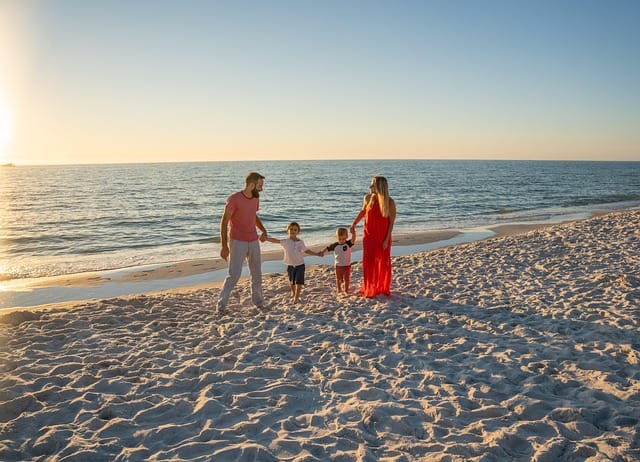
When it comes to sunset beach family photos, the right outfit choices can elevate your images from casual snapshots to timeless portraits. Clothing plays a crucial role in how your photos feel — it influences color harmony, mood, and even how natural your family appears in the beach setting.
This section provides a complete guide on what to wear, what to avoid, and how to coordinate family outfits to perfectly complement the glowing tones of the sunset and the soft, neutral textures of the beach.
1. Why Outfit Choice Matters for Beach Photography
Beach environments are open, bright, and reflective — meaning colors, textures, and fabrics react differently to the light.
At sunset, warm golden hues dominate the scene, and the ocean and sky add soft blues and pinks. The right outfit enhances these tones, while the wrong ones may create harsh contrasts or distractions.
A good outfit choice:
- Complements the beach palette (warm, soft, or neutral colors).
- Reflects your family’s personality and natural dynamic.
- Moves gracefully with wind and light.
- Keeps the overall tone cohesive, not clashing.
“The right outfit doesn’t just look good — it feels like part of the landscape.”
— Erin Cole, Coastal Family Photographer
2. Best Colors to Wear for Sunset Beach Family Photos
The golden hour light interacts beautifully with muted, warm, and natural tones. These colors reflect the soft glow of sunset while blending seamlessly with sand and sea.
| Color Palette | Examples | Why It Works |
| Neutrals | Cream, beige, ivory, taupe | Reflects sunlight naturally; timeless and soft |
| Pastels | Blush, dusty blue, sage, lavender | Enhances dreamy, romantic tone |
| Earthy Tones | Terracotta, olive, tan, sand | Complements sunset hues and natural surroundings |
| Warm Tones | Mustard, coral, rust, peach | Accentuates the golden hour glow |
💡 Pro Tip: For balance, mix one warm tone (like rust or coral) with neutrals for visual harmony.
3. Colors to Avoid
Some colors can overpower the warm tones of sunset or reflect poorly on the skin.
🚫 Avoid:
- Bright white (can overexpose and reflect too much light)
- Neon or fluorescent shades (clash with natural tones)
- Black (absorbs light, reducing warmth)
- Bright reds or greens (reflect unnatural hues on skin)
- Large, bold prints or logos (distracting from faces)
Instead, aim for soft, blended hues that allow your family to feel part of the environment — not separate from it.
4. Coordinating Family Outfits
Family photos look best when outfits coordinate without matching exactly. The goal is harmony, not uniformity.
Here’s how to achieve a balanced look:
- Choose a color palette (2–3 tones).
Example: beige, blush, and soft blue. - Assign tones by role.
- Mom in a flowing neutral dress.
- Dad in a soft blue linen shirt and tan pants.
- Kids in lighter variations of the same tones.
- Mom in a flowing neutral dress.
- Mix textures — linen, cotton, and lace add dimension.
- Avoid identical outfits. Instead, create variety within the theme.
📸 Example Family Palette:
Creams + Dusty Rose + Warm Sand tones create cohesive warmth under sunset light.
5. Fabric and Texture Choices
Since you’re shooting on the beach, comfort and movement are just as important as appearance.
Recommended Fabrics:
- Linen – lightweight and airy, ideal for wind flow.
- Cotton – natural and breathable.
- Chiffon or rayon – elegant flow in movement shots.
- Knits – add texture without bulk.
Avoid synthetic materials like polyester — they reflect harsh light and trap heat.
🌊 Pro Tip: Flowy fabrics create stunning motion effects in the breeze — perfect for romantic or candid family portraits.
6. Footwear and Accessories
For beach photos, barefoot looks best. It adds a natural, relaxed touch and prevents sand-related discomfort.
If shoes are necessary:
- Choose neutral sandals or woven flats.
- Avoid sneakers or heels (they look out of place on sand).
Accessories:
- Wide-brim hats for personality (great for silhouette shots).
- Light jewelry that catches the sunset glow.
- A neutral-toned blanket or shawl can double as a prop.
💡 Bonus Tip: Keep accessories minimal to avoid drawing focus away from faces.
7. Outfit Planning for Different Family Members
| Family Member | Outfit Suggestions | Notes |
| Mom | Maxi dress or skirt in soft, flowy fabric | Adds elegance and movement |
| Dad | Linen or cotton shirt with khaki or tan shorts | Keep casual yet coordinated |
| Kids | Rompers, shorts, or dresses in similar tones | Prioritize comfort and playability |
| Babies | Neutral romper, simple bow or bonnet | Avoid prints or patterns that distract |
👗 Styling Tip: Keep everyone’s clothing simple enough that expressions and interactions remain the highlight.
8. Hair and Makeup Tips
Wind and humidity can affect your look, so aim for natural, weather-friendly styles.
Hair Tips:
- Loose waves or braids suit beach aesthetics.
- Bring clips or pins for windy conditions.
- Avoid overly styled or stiff hairdos — flow is key.
Makeup Tips:
- Use waterproof mascara and light foundation.
- Add bronzer and highlight to enhance golden light.
- Choose neutral lip shades — peach, coral, or nude tones.
✨ Pro Tip: Keep makeup matte — shimmer can reflect light too harshly in close-ups.
9. Props and Styling Enhancements
Props can add personality and storytelling to your beach session — just keep them subtle.
Creative prop ideas:
- Neutral picnic blanket or woven basket.
- Seashells or driftwood for children to interact with.
- A cozy family wrap or throw for seated shots.
- Matching flower crowns or garlands for a soft touch.
Avoid large, artificial props that look staged. Natural elements always blend better with beach scenery.
10. Case Study: The Harper Family’s Coordinated Sunset Session
The Harper family in Malibu chose a palette of cream, blush, and sandy tan for their golden-hour session.
- Mom wore a flowing cream maxi dress.
- Dad dressed in a light tan shirt and rolled-up pants.
- The children wore pastel blush and ivory tones.
Their clothing not only matched the warm tones of the sky but also reflected soft light beautifully on their skin. The result was a gallery of cohesive, glowing portraits where the family and environment felt in perfect harmony — a classic example of how color coordination elevates storytelling.
Key Takeaways
- Choose soft, natural, and warm colors that complement sunset tones.
- Avoid bright whites, neons, and harsh blacks.
- Coordinate rather than match for visual balance.
- Opt for lightweight, flowy fabrics to enhance movement.
- Keep accessories minimal and authentic.
Posing with Purpose: Capturing Emotion and Connection in Sunset Beach Family Photos
Beautiful scenery and perfect lighting mean little without authentic emotion. The secret to unforgettable sunset beach family photos lies not just in technique but in connection — between family members, with the photographer, and with the environment. Great posing is not about stiffness or perfection; it’s about storytelling, movement, and genuine interaction.
In this section, we’ll cover expert posing techniques, how to make families feel comfortable, and how to capture raw emotion that transforms an image into a timeless memory.
1. Why Emotion and Connection Matter More Than Perfect Poses
Sunset beach photography is all about capturing feeling — the gentle laughter, shared glances, or quiet stillness between loved ones.
When people see your photo, they shouldn’t just admire it — they should feel it.
While technical elements like lighting and framing are vital, emotion drives engagement. A genuine smile or playful interaction will always outperform a stiff, perfectly symmetrical pose.
“People remember how your photos make them feel, not how technically perfect they are.”
— Mia Lane, Lifestyle Photographer
2. Creating a Comfortable Atmosphere
Most families aren’t models — and that’s a good thing. Your job (or your photographer’s) is to help everyone feel natural and at ease in front of the camera.
Here’s how to create a relaxed environment:
- Start with conversation. Ask about their day, family traditions, or favorite vacation memories.
- Give gentle direction rather than rigid instructions.
- Encourage interaction, like whispering a joke or tickling a child.
- Play music during the shoot for a more natural vibe.
💡 Pro Tip: Keep children engaged with small games like “run to Mom!” or “show me your biggest laugh.” It creates spontaneous joy that looks perfect on camera.
3. Classic Family Poses that Always Work
Every beach session should include a mix of classic and candid poses. Here are a few reliable setups that flatter every family:
| Pose Name | Description | Emotion it Captures |
| The Walk Together | Family walks hand-in-hand along the shoreline. | Unity, connection, natural rhythm |
| The Cuddle Pose | Family gathers closely, arms around each other. | Warmth, love, belonging |
| The Circle Sit | Everyone sits in a circle on the sand. | Togetherness, conversation |
| The Shoulder Hold | Parent lifts or carries child on shoulders. | Joy, playfulness |
| The Sunset Hug | Group hug facing the sunset. | Serenity, peace |
| The Whisper Pose | Kids whisper to each other or to parents. | Laughter, candid sweetness |
Each pose works beautifully during the golden hour, where even small gestures become emotionally powerful under soft, glowing light.
4. Posing Tips for Different Family Dynamics
Every family interacts differently — your posing should reflect their unique personality.
For Families with Young Children
- Let them play! Capture splashing water, running, or building sandcastles.
- Encourage parents to crouch down to their kids’ level.
- Use prompts like “run and hug Mom!” or “look at Daddy and giggle.”
For Couples or Parents
- Focus on touch — hands intertwined, heads resting together.
- Capture natural laughter and soft gazes.
- Encourage movement: walking barefoot, slow dancing in the waves.
For Larger Families
- Use triangles in composition — taller members behind, shorter in front.
- Keep interactions layered: kids playing in foreground, parents behind.
- Capture both group and sub-group interactions for storytelling variety.
📷 Pro Tip: Large families benefit from candid layering shots — where not everyone is looking at the camera, but the energy feels authentic and alive.
5. Posing with Movement
The ocean is full of motion — and movement adds life to your images. Encourage your family to move naturally through activities.
Movement ideas for dynamic poses:
- Walking or running along the shore.
- Tossing shells into the sea.
- Twirling or spinning with children.
- Jumping waves or dancing barefoot in the surf.
- Wrapping up together in a blanket as the sun sets.
Why movement matters:
Movement relaxes tension and creates natural smiles and candid energy. Plus, it makes clothing and hair flow beautifully in the wind — perfect for that golden-hour glow.
6. The Power of Touch and Eye Contact
In photography, connection often shows through subtle gestures — a parent brushing hair away, siblings holding hands, or shared laughter between partners.
To capture intimacy:
- Encourage light physical contact — holding hands, gentle touches, or arms around shoulders.
- Use eye contact strategically — sometimes looking at each other feels warmer than looking at the camera.
- Mix connected poses (everyone close) with open, environmental ones (spread along the shore).
“Touch and gaze are the language of connection. Capture that, and you’ve captured their bond.”
— Lucas Gray, Family Photographer, Australia
7. Working with the Sunset Light
Positioning matters. The golden-hour sun creates natural rim light, which outlines the family with a warm halo.
Tips:
- Face subjects slightly away from the sun for soft, even skin tones.
- Use backlighting for glowing silhouettes and dreamy flares.
- Capture side lighting for depth and texture on faces.
- Adjust your position every few minutes as the sun lowers — colors change rapidly.
💡 Pro Tip: Keep the sun just outside the frame to avoid harsh flares while maintaining a radiant backdrop.
8. Posing for Candid Emotion
Sometimes the best moments are unplanned. Candid posing isn’t about doing nothing — it’s about creating opportunities for real interaction.
Prompt Ideas:
- “Walk toward me, then look at each other and laugh.”
- “Tell your child your favorite memory of them.”
- “Run to the water and splash together.”
- “Hold hands, close your eyes, and take a deep breath together.”
These prompts lead to genuine expressions that make your sunset beach family photos stand out emotionally and visually.
9. Incorporating the Environment
Let the ocean, sky, and sand become part of the composition. Position family members where the environment enhances emotion, not just decorates it.
Creative ideas:
- Have kids chase seagulls while parents watch lovingly.
- Use reflections in wet sand for mirror-like symmetry.
- Frame silhouettes against pink and orange skies.
- Capture footprints leading toward the horizon for symbolic depth.
Each shot becomes a small piece of a larger story — one of family, time, and nature in harmony.
10. Case Study: The Jensen Family – Outer Banks, NC
The Jensen family of five wanted authentic, emotion-filled portraits that reflected their playful bond.
Their photographer used a mix of guided poses and natural moments — starting with structured group shots, then transitioning into free play as the sun dipped.
The results?
- Stunning silhouettes framed by orange skies.
- Genuine laughter during “run to Mom!” prompts.
- Tender close-ups as parents held their youngest while waves lapped at their feet.
The session’s final gallery was a perfect balance of posed elegance and raw connection — exactly what every family hopes for in their sunset beach session.
Key Takeaways
- Focus on emotion over perfection.
- Use prompts and interaction to create authentic smiles.
- Let movement and touch guide natural posing.
- Adjust to golden-hour light for warmth and depth.
- Capture both structured portraits and candid stories.
Essential Gear and Camera Settings for Perfect Sunset Beach Family Photos
Even the most emotional and well-posed sunset beach family photos can fall flat without the right equipment and camera settings. The interplay between light, lens, and exposure is what brings out the warmth, texture, and atmosphere that make these images magical. Whether you’re a professional photographer or a parent capturing memories, understanding your gear is the foundation of success.
This section explores the best cameras, lenses, and accessories, along with step-by-step camera settings for beach photography at sunset — so your images come out sharp, vibrant, and full of depth.
1. Essential Camera Gear for Sunset Beach Photography
Choosing the right gear ensures that your photos capture every golden ray and natural smile without losing detail or clarity.
Here’s a breakdown of what you’ll need:
| Equipment | Why It’s Important | Pro Tip |
| DSLR or Mirrorless Camera | Offers manual control, large sensor, and dynamic range to handle backlight and low light. | Full-frame sensors capture better tonal range at sunset. |
| Lens (35mm or 50mm Prime) | Perfect for portraits — produces soft background blur (bokeh) and sharp subjects. | A 35mm lens gives environmental context; 50mm adds intimacy. |
| Zoom Lens (24-70mm or 70-200mm) | Adds flexibility for wide scenes or close-ups without moving too much. | Ideal for group shots and candid captures from a distance. |
| Reflector or Diffuser | Balances harsh light, fills shadows on faces. | Use gold reflectors for warmth that matches the sunset glow. |
| Tripod | Keeps camera steady for slow-shutter captures or family group shots. | Essential for long exposures when the light gets low. |
| Lens Hood | Prevents flare from direct sunlight and improves color contrast. | Always use when shooting toward the sun. |
| Backup Batteries & SD Cards | Sunset sessions often run longer than expected — don’t lose shots to dead batteries! | Keep extras charged and easily accessible. |
💡 Pro Tip: If you’re just starting out, prioritize a mid-range mirrorless camera and a 35mm f/1.8 prime lens — that combo gives professional-quality results without breaking the bank.
2. Camera Settings for Sunset Beach Family Photos
The key to perfect sunset beach photography is balancing exposure — ensuring that the background sky remains vibrant while your subjects are well-lit.
Let’s break it down by setting:
A. ISO
- Start at ISO 100–400 when the sun is still bright.
- Gradually raise it to 800–1600 as light fades.
- Avoid going too high unless your camera handles noise well.
B. Aperture (f-stop)
- For soft, dreamy backgrounds: f/1.8–f/2.8.
- For group shots needing sharp focus across faces: f/4–f/5.6.
- For scenic wide shots: f/8–f/11 to capture detail from foreground to background.
C. Shutter Speed
- For portraits and natural movement: 1/250s–1/500s.
- For running children or motion shots: 1/1000s or faster.
- For artistic blur (waves, dancing light): use a tripod and slow shutter 1/15s–1/30s.
D. White Balance
- Set to “Cloudy” or “Shade” to enhance warm tones naturally.
- Avoid Auto White Balance (AWB) — it may neutralize the golden tones you want to preserve.
E. Focus Mode
- Use Continuous Autofocus (AF-C) for moving subjects like kids.
- For posed shots, switch to Single Point Focus to keep eyes sharp.
3. Best Time to Shoot: The Golden Hour and Beyond
Timing makes all the difference.
| Time of Day | Lighting Qualities | Ideal Shots |
| 1 Hour Before Sunset | Warm, directional light with soft shadows. | Family group portraits, playful candids. |
| 30 Minutes Before Sunset | Golden light intensifies, sky glows orange-pink. | Emotional moments, silhouettes, close-ups. |
| Sunset to 15 Minutes After | Deep hues and gentle twilight tones. | Silhouette shots, artistic compositions. |
| 15–30 Minutes After Sunset (Blue Hour) | Cool, soft tones — perfect for dramatic mood shots. | Reflective, calm family portraits. |
💡 Pro Tip: The sweet spot for most family photos is 30–45 minutes before the sun dips — perfect warmth, manageable light, and relaxed energy.
4. Using Natural and Artificial Light Together
Even with sunset light, you may need a little boost.
Light balancing options:
- Reflector: Use a gold or white reflector to bounce sunlight onto faces.
- Off-camera flash: Add subtle fill light if subjects appear too dark against the bright sky.
- LED panel: Great for gentle, continuous illumination — especially for kids who move unpredictably.
Avoid: On-camera flash. It flattens features and kills the natural sunset glow.
5. Camera Settings Cheat Sheet
| Shot Type | ISO | Aperture | Shutter Speed | White Balance |
| Golden Hour Portraits | 100–400 | f/2.8–f/4 | 1/250s | Cloudy |
| Family Group Shot | 200–800 | f/5.6–f/8 | 1/200s | Shade |
| Candid Movement (Running Kids) | 400–800 | f/3.5 | 1/1000s | Cloudy |
| Silhouette | 100 | f/8 | 1/500s | Daylight |
| Blue Hour Close-ups | 800–1600 | f/1.8–f/2.8 | 1/100s | Shade |
Keep this cheat sheet handy to adapt quickly as lighting changes.
6. Pro-Level Tips for Beach Shooting Conditions
- Avoid saltwater spray — it can leave marks on your lens. Bring a microfiber cloth.
- Protect gear from sand using plastic covers or lens guards.
- Use manual exposure to maintain control when light shifts rapidly.
- Bracket exposures (take multiple shots at different brightness levels) for HDR editing later.
- Shoot in RAW format — it preserves more color and detail for editing.
💡 Pro Tip: Always review shots on your LCD using the histogram, not just the image preview. It helps ensure your highlights aren’t blown out by bright skies.
7. Real-World Example: The “Perfect Light” Session
During a family shoot in Santa Monica, photographer Lisa Mendez arrived 45 minutes before sunset.
Her settings: ISO 200, f/3.5, 1/400s, White Balance “Cloudy.”
She used a gold reflector to fill shadows while keeping the sky rich and vibrant.
The result?
- The family’s faces were illuminated with warm tones.
- The sky retained deep oranges and pinks.
- No artificial light was needed — only perfect timing and simple tools.
This case perfectly illustrates how understanding your settings can elevate natural light into pure magic.
8. Common Mistakes to Avoid
Even experienced photographers sometimes struggle with sunset sessions. Avoid these pitfalls:
- ❌ Overexposing the background: Leads to washed-out skies.
- ❌ Underexposing faces: Causes dull, shadowed subjects.
- ❌ Using Auto Mode: The camera won’t understand complex lighting.
- ❌ Shooting too late: Light fades fast — plan ahead!
- ❌ Ignoring direction of light: Position families with sun at their side or back for soft glow.
✅ Fix: Use spot metering, manual exposure, and a quick test shot before each major setup.
9. Key Takeaways
- Use manual settings to control light and color.
- Choose prime lenses for stunning portrait sharpness.
- Shoot during golden hour for the best natural light.
- Combine reflectors and RAW format for perfect exposure.
- Protect your gear and plan for changing light conditions.
Editing and Post-Processing Tips for Sunset Beach Family Photos
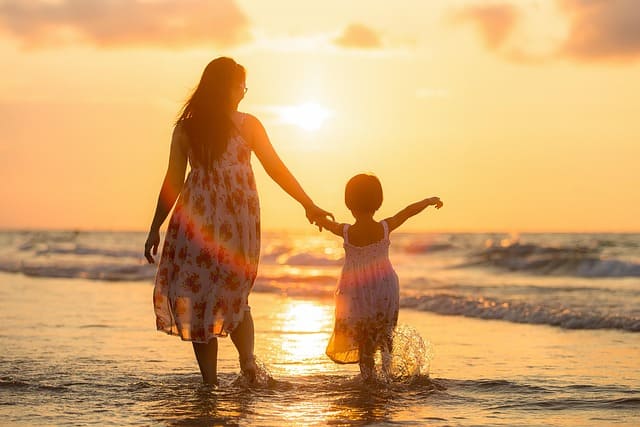
Capturing stunning sunset beach family photos doesn’t end with the camera — it continues in the editing room. Post-processing is where your images truly come alive, allowing you to enhance colors, balance exposure, and refine tones without losing the authenticity of the moment. When done correctly, editing turns great photos into breathtaking ones — while maintaining the warm, emotional atmosphere that defines sunset photography.
In this section, we’ll walk through a complete step-by-step editing process, recommended tools, common mistakes to avoid, and color enhancement tips tailored for sunset beach photos.
1. Why Post-Processing Matters for Sunset Beach Photos
Even with perfect lighting and camera settings, RAW files can look a little flat straight out of the camera. This is because RAW captures maximum detail but doesn’t apply contrast or color enhancements automatically.
Post-processing allows you to:
- Recover lost detail in highlights or shadows.
- Enhance natural golden tones without over-saturation.
- Balance skin tones under mixed warm and cool lighting.
- Add artistic touches that express your personal style.
In short, editing bridges the gap between what your camera sees and what your eyes felt in that magical sunset moment.
2. The Best Editing Tools for Photographers
Here are some top tools professionals use to edit sunset beach family photos effectively:
| Tool | Best For | Why Use It |
| Adobe Lightroom | Color correction, tonal balance, presets | Easy batch editing and intuitive sliders. |
| Adobe Photoshop | Advanced retouching, object removal | Great for sky blending, blemish fixes, or composite images. |
| Capture One | Professional-grade RAW editing | Exceptional color control and detail recovery. |
| Luminar Neo | AI-based enhancement | Quick sky correction and lighting adjustments. |
| Canva / Fotor | Beginners & social sharing | Simple one-click filters and adjustments. |
💡 Pro Tip: For professional results, use Lightroom for color grading and Photoshop for local touch-ups (like removing distractions or flyaway hair).
3. Step-by-Step Editing Workflow
A. Import and Organize
- Import your RAW images into Lightroom or Capture One.
- Flag the best shots and discard duplicates or test frames.
- Create a backup — editing can’t fix lost files!
B. Basic Adjustments
Start with the Basic Panel in Lightroom:
| Setting | Ideal Range | Purpose |
| Exposure | +0.25 to +0.50 | Brightens overall photo. |
| Contrast | +10 to +25 | Adds depth and separation. |
| Highlights | -20 to -40 | Recovers sky detail. |
| Shadows | +20 to +50 | Brings out facial details. |
| Whites/Blacks | Adjust until histogram balances | Ensures full tonal range. |
| Clarity | +10 | Adds subtle mid-tone contrast. |
| Vibrance | +15 | Boosts color naturally. |
| Saturation | +5 | Use sparingly to avoid oversaturation. |
💡 Editing Tip: Always check your histogram to avoid clipping — especially in the bright sunset areas.
C. Color Correction and White Balance
Sunsets naturally create warm hues, but sometimes your camera’s white balance may lean too orange or pink.
Adjust White Balance manually:
- Temp: Between 4800K–5500K (for golden warmth).
- Tint: +10 to +20 (to counteract green tones).
If skin tones look too orange, slightly lower Temp to restore balance.
D. Enhance the Sky and Background
Sunsets are all about drama in the sky. To enhance it:
- Use the Graduated Filter tool in Lightroom.
- Lower Exposure (-0.3 to -0.5) and increase Saturation (+10 to +20).
- Add a hint of Dehaze (+5 to +10) to bring out clouds and colors.
You can also subtly increase contrast in the sky area only, so your subjects stand out more.
E. Skin Tone and Portrait Enhancement
Sunset lighting can sometimes make skin tones uneven. Fix that using:
- Adjustment Brush: Paint lightly over faces and reduce warmth slightly.
- Texture & Clarity: Keep low (+5) to maintain soft, natural look.
- Remove distractions in Photoshop using Spot Healing or Clone Stamp.
💡 Pro Tip: Keep skin natural. Sunset glow should enhance, not overpower, the complexion.
F. Sharpening and Noise Reduction
As light fades, ISO tends to increase — bringing noise.
- Noise Reduction: Luminance 15–25, Detail 50.
- Sharpening: Amount 50–70, Radius 1.0.
- Mask sharpening to affect only edges (hold Alt key while adjusting in Lightroom).
This keeps details crisp without grainy results.
4. Creative Color Grading Techniques
Once your basic edits are done, move to creative styling:
- Warm Shadows: Add subtle orange or magenta tones in the shadows panel.
- Teal & Orange Look: Apply warm highlights and cool shadows for cinematic depth.
- Matte Finish: Raise the blacks slightly for a soft, filmic texture.
💡 Use Lightroom Presets designed for golden hour photography. They save time and maintain consistency across your photo set.
5. Before and After Example
| Step | Description | Result |
| Original RAW | Flat, low contrast, unedited file | Lacks warmth and clarity |
| After Basic Adjustments | Balanced exposure, restored detail | Improved depth and tone |
| After Color Grading | Enhanced golden hues, sky contrast | Warm, professional finish |
| Final Touches | Skin corrections, sharpening | Print-ready masterpiece |
6. Common Editing Mistakes to Avoid
- ❌ Over-saturating the sunset: Makes images look fake.
- ❌ Whitening skin excessively: Removes the natural warmth of sunset light.
- ❌ Ignoring shadows: Flat images lack depth.
- ❌ Over-smoothing faces: Creates unrealistic “plastic” effect.
- ❌ Skipping color calibration: Every monitor shows different colors — always check your edits on multiple screens.
7. Bonus: Editing for Social Media and Print
For Instagram & Web:
- Export size: 2048 px (long edge).
- Resolution: 72 dpi.
- Sharpen for screen display.
- Add watermark if needed.
For Prints or Albums:
- Export as TIFF or high-quality JPEG.
- Resolution: 300 dpi.
- Use sRGB color profile for labs or Adobe RGB for professional printers.
8. Expert Insight
“The key to editing sunset beach family photos is restraint. The light is already doing the storytelling — your job is to polish, not overpower.”
— Daniel Reyes, Professional Family Photographer, California
9. Key Takeaways
- Always shoot in RAW for maximum flexibility during editing.
- Prioritize color balance and detail recovery over heavy filters.
- Use graduated filters and selective adjustments to enhance the sunset without distorting it.
- Keep skin tones natural, warm, and lifelike.
- Export in the right formats for your intended use (web or print).
Creative Posing and Composition Ideas for Sunset Beach Family Photos
One of the most rewarding aspects of capturing sunset beach family photos is the opportunity to blend storytelling, emotion, and artistry into every frame. The golden hour’s lighting creates endless possibilities for beautiful compositions — but it takes skillful posing and creative direction to bring out the genuine connections and natural movement that make family portraits shine.
In this section, we’ll explore pose ideas, composition techniques, and natural interaction prompts that help families look relaxed, cohesive, and radiant against the stunning backdrop of a setting sun.
1. The Importance of Posing and Composition
Composition is the backbone of visual storytelling. It guides the viewer’s eye, sets the emotional tone, and frames your subjects within the beauty of their environment.
Posing, on the other hand, is what turns a still photo into a moment of connection. When families interact naturally — laughing, hugging, walking — it reflects authentic emotion that’s far more compelling than stiff, formal setups.
Together, posing and composition make sunset family portraits feel like heartfelt memories, not just pictures.
2. Basic Composition Rules for Sunset Photography
Here are some composition principles that will instantly elevate your photos:
| Technique | Description | Why It Works |
| Rule of Thirds | Place subjects off-center along grid lines | Creates balance and visual interest |
| Leading Lines | Use shoreline, waves, or reflections to guide the eye | Adds depth and motion |
| Framing | Frame family between natural elements (rocks, dunes, sun) | Focuses attention on subjects |
| Silhouette Composition | Capture dark figures against glowing sky | Evokes emotion and drama |
| Symmetry & Reflection | Use wet sand or water to mirror subjects | Adds harmony and artistic balance |
💡 Pro Tip: Don’t be afraid to break composition rules once you master them. Sometimes, a centered shot or wide negative space creates more impact, especially at sunset.
3. Posing Ideas for Families
Here’s a collection of creative and natural sunset beach family photo poses to inspire your session:
A. Walking Together Along the Shore
- Have the family walk hand-in-hand along the waterline.
- Encourage laughter, conversation, or gentle splashing.
- Capture both wide scenic shots and close-ups of hands or footprints.
This pose creates movement and togetherness, perfect for storytelling compositions.
B. Group Hug or Family Cuddle
- Ask the family to group tightly, heads close together.
- Have parents hug kids from behind or lift smaller ones into their arms.
- Capture genuine smiles and eye contact.
This conveys warmth and unity, especially in golden light.
C. Playtime and Laughter
- Let kids run, chase bubbles, or jump waves.
- Have parents watch, laugh, or join in.
- Shoot from a lower angle to make the action more dynamic.
These are authentic lifestyle shots — full of energy and joy.
D. Sitting or Cuddling on a Blanket
- Spread a neutral-toned blanket near the shore.
- Have the family sit close, interacting naturally.
- Encourage whispers, storytelling, or pointing toward the sunset.
Perfect for intimate, peaceful portraits that highlight connection.
E. Silhouette Poses
- Position the family between your lens and the sun.
- Instruct them to hold hands, jump, or lift a child.
- Expose for the sky to create dark outlines against glowing color.
These artistic shots add drama and emotional impact.
4. Creative Composition Examples
| Shot Type | Composition Focus | Mood/Effect |
| Wide Landscape Family Shot | Family small against grand sunset sky | Dramatic and cinematic |
| Mid-Range Group Portrait | Rule of thirds, natural smiles | Balanced and heartwarming |
| Close-Up Detail Shot | Hands, faces, or footprints | Intimate and emotional |
| Reflection Shot | Wet sand doubles colors and shapes | Dreamy and artistic |
| Silhouette Jump or Hug | Family framed by glowing sun | Symbolic and bold |
💡 Pro Tip: Shoot both horizontal and vertical orientations. Horizontal emphasizes scenery; vertical draws focus to emotion and detail.
5. Interaction Prompts for Natural Expressions
Instead of saying “smile,” guide your subjects with gentle prompts that create real emotion. Here are some photographer favorites:
- “Walk slowly toward me while looking at each other.”
- “Whisper a funny secret in Mom’s ear.”
- “Run and catch Dad before he gets to the water!”
- “Everyone look at the person who laughs the loudest.”
- “Let’s all close our eyes and take a deep breath together.”
These prompts generate authentic reactions, perfect for families who may feel camera-shy at first.
6. Using the Environment to Your Advantage
The beach itself is your co-star in sunset family photography.
Use natural elements creatively:
- Waves: Reflect light, add energy and texture.
- Sand: Perfect for footprints, sitting poses, or playful interactions.
- Driftwood and rocks: Create depth and foreground interest.
- Sky gradient: Frame subjects so the color transition complements their clothing tones.
- Sun position: Shoot with the sun behind your subjects for glowing hair light or to create silhouettes.
7. Case Study: The “Sunset Walk” Session
Photographer Kara James worked with a family of five in Florida for a golden hour shoot.
Instead of strict posing, she gave simple prompts like “walk toward the camera and talk about your favorite vacation memory.”
The family’s laughter was natural, their movements fluid, and the warm light wrapped around them perfectly.
Her final gallery featured:
- 30% posed shots (framed compositions)
- 70% candid moments (interaction-based storytelling)
This balance created a photo collection that felt genuine, dynamic, and deeply emotional — the hallmark of great sunset photography.
8. Common Posing Mistakes to Avoid
- ❌ Over-posing: Makes families look stiff and unnatural.
- ❌ Ignoring height levels: Mix standing, sitting, and kneeling for balance.
- ❌ Facing directly into the sun: Causes squinting and harsh highlights.
- ❌ Forgetting candid shots: Sometimes the in-between moments are the best.
- ❌ Neglecting composition: Always check background elements for distractions.
9. Key Takeaways
- Use composition principles like rule of thirds, leading lines, and reflections for depth.
- Encourage movement and interaction for genuine emotion.
- Blend posed and candid moments for a well-rounded photo collection.
- Let the beach environment shape your story naturally.
- Capture a mix of wide landscapes and intimate close-ups for variety.
What to Wear for Sunset Beach Family Photos
Choosing the right outfits can completely transform the look and feel of your sunset beach family photos. Clothing sets the tone — it can either harmonize beautifully with the golden hues of sunset or distract from the natural beauty of the setting. The goal is to choose colors, textures, and styles that complement both your family’s personality and the soft, glowing palette of the beach at sunset.
In this section, we’ll explore color palettes, outfit coordination ideas, fabric choices, and style dos and don’ts to ensure your family looks effortlessly polished and photo-ready.
1. Why Outfit Choices Matter
At golden hour, every detail matters. The warm tones of the sun interact with clothing colors in powerful ways.
Soft neutrals and earthy hues reflect the light beautifully, creating a cohesive, natural aesthetic — while overly bright or mismatched outfits can overpower the serene background.
When styled well, your outfits:
- Enhance your skin tones.
- Complement the golden light and beach tones.
- Make your photos feel timeless, natural, and elegant.
- Keep attention on your faces, not your clothes.
2. Ideal Color Palettes for Sunset Beach Family Photos
The best colors are those inspired by nature itself — think muted, earthy, and pastel tones that blend seamlessly with the sand, sea, and sky.
Here are some tried-and-true color palettes:
| Color Theme | Color Examples | Mood/Effect |
| Neutrals & Earthy Tones | Beige, taupe, cream, soft brown, ivory | Natural, timeless, warm |
| Ocean-Inspired Blues | Sky blue, navy, slate, dusty teal | Fresh, cool contrast to warm sunset tones |
| Soft Pastels | Blush, peach, lavender, sage | Gentle, romantic, and flattering |
| Warm Tones | Terracotta, mustard, burnt orange, rust | Rich and vibrant against sunset glow |
| White & Off-White | Pure white, ivory, eggshell | Clean and luminous against golden light |
💡 Pro Tip: Choose 2–3 complementary tones and have each family member wear a variation. This creates visual harmony without looking “too matchy.”
3. Outfit Coordination Ideas by Family Type
A. Classic Coastal Look
- Colors: Ivory, beige, dusty blue, light gray.
- Fabrics: Linen, cotton, flowy chiffon.
- Style Tips: Barefoot, rolled-up pants, or sundresses.
→ Perfect for simple, elegant family portraits.
B. Warm Bohemian Vibes
- Colors: Rust, mustard, olive, cream.
- Fabrics: Flowy maxi dresses, textured knits.
- Accessories: Straw hats, woven belts, minimal jewelry.
→ Works beautifully with orange-pink sunsets.
C. Modern Minimalist Look
- Colors: Monochrome palette (beige, white, gray).
- Style: Simple silhouettes, structured outfits.
- Footwear: Neutral sandals or barefoot.
→ Ideal for chic, editorial-style family photos.
D. Vibrant Pop of Color
- Colors: Coral, turquoise, soft yellow.
- Style: Keep one family member in a pop color while others stay neutral.
- Balance: Use accessories to repeat that color subtly.
→ Adds fun and personality without overwhelming the frame.
4. Best Fabrics and Textures
The beach setting calls for lightweight, breathable, and flowy fabrics that move beautifully in the breeze.
| Fabric Type | Why It Works |
| Linen | Natural, airy, and textured — perfect for warm tones. |
| Cotton | Comfortable and classic for kids and adults alike. |
| Chiffon / Silk | Adds elegance and fluidity in movement shots. |
| Knits | Provide subtle texture and visual depth. |
Avoid heavy fabrics (like denim jackets or wool) and anything that clings too tightly — beach sessions often involve movement and a little wind.
5. Clothing Tips for Each Family Member
Parents:
- Mothers: Maxi dresses or midi skirts in soft tones look stunning at sunset.
- Fathers: Linen shirts or casual button-downs with rolled sleeves.
Children:
- Keep it simple — avoid logos or neon colors.
- Flowy dresses, rompers, or linen shirts and shorts.
- Barefoot or light sandals for comfort.
Babies & Toddlers:
- Soft, neutral onesies or cotton rompers.
- Minimal headbands or hats to avoid distractions.
💡 Pro Tip: Keep a backup outfit for kids (accidents happen — especially near sand and water).
6. Accessories That Add Personality (Without Overpowering)
Accessories can elevate your look, but moderation is key.
Recommended:
- Straw hats or wide-brimmed sun hats.
- Minimal jewelry (gold, rose gold, or wooden tones).
- Flowing scarves that move gracefully with the wind.
- Light blankets or throws in neutral tones for sitting shots.
Avoid:
- Large statement jewelry or shiny metal.
- Heavy belts or loud patterns.
- Sunglasses (unless for candid, lifestyle shots).
7. Outfit Coordination Tips for a Cohesive Look
- Choose one color palette, not identical outfits.
- Balance patterns — if one person wears print, others wear solids.
- Avoid large logos or words.
- Stick to complementary tones, not clashing hues.
- Consider the background — if the sky will be warm, cool-toned outfits balance beautifully.
💡 Pro Tip: Lay all outfits together on a bed before the session. If they look balanced together there, they’ll photograph well together too.
8. Case Study: Coordinated, Not Matching
Photographer Hannah Lee styled a family of six for a Maui sunset shoot using a warm, sandy palette:
- Mom wore a flowing peach maxi dress.
- Dad wore a beige linen shirt and khaki shorts.
- Kids wore off-white and dusty blue.
Result: The color harmony allowed the sunset’s glow to blend seamlessly with their outfits, producing timeless, magazine-worthy images.
9. Common Outfit Mistakes to Avoid
- ❌ Overly bright neon colors (they reflect on skin and ruin tones).
- ❌ Distracting patterns or logos.
- ❌ High heels (sink in sand and limit movement).
- ❌ Heavy fabrics or dark black clothing (absorbs light).
- ❌ Matching identical outfits (looks outdated).
✅ Fix: Go for soft coordination — think variety within harmony.
10. Key Takeaways
- Stick to earthy, soft, or pastel tones that complement sunset hues.
- Choose light, flowy fabrics for comfort and motion.
- Mix and match tones — not identical outfits.
- Avoid bright or distracting elements.
- Let your outfits support the story, not steal the spotlight.
Posing Tips for Families with Kids During Sunset Beach Family Photos
Posing for sunset beach family photos can be both exciting and a little chaotic — especially when kids are involved! The key to stunning, natural images is not forcing perfection but embracing authentic, emotional moments. A great photographer will guide you, but understanding how to pose, move, and interact as a family helps you feel confident and comfortable in front of the camera.
Let’s dive into expert posing techniques, child-friendly engagement ideas, and tips for candid magic during your beach photo session.
1. Why Natural Posing Works Best at Sunset
The beach is inherently relaxed and full of movement — waves crashing, wind blowing, kids running — and your poses should reflect that same energy.
During golden hour, the light is soft and directional, highlighting emotions beautifully. Rather than stiff, posed portraits, focus on connection and interaction.
Natural posing advantages:
- Captures genuine family dynamics.
- Works perfectly with wind, sand, and sunlight.
- Makes children feel free and expressive.
- Creates timeless, candid images you’ll cherish forever.
💡 Pro Tip: Think “moments,” not “poses.” Aim for laughter, hugs, and playful gestures — not rigid stances.
2. Warm-Up Shots: Getting Comfortable in Front of the Camera
Even adults can feel camera-shy at first. Start your session with easy, low-pressure shots that allow everyone to relax.
Examples of warm-up poses:
- Walking hand-in-hand along the shoreline.
- Sitting together in the sand.
- Parents lifting toddlers in the air.
- Kids running toward the camera.
These actions create movement and laughter naturally. Once everyone loosens up, you can move to more composed family groupings.
3. Classic Family Poses That Always Work
Below are timeless posing setups that work beautifully for sunset beach family photos:
| Pose Type | Description | Why It Works |
| The Walk Along the Shore | Family walks casually, holding hands. | Natural motion + soft sunset light = cinematic shots. |
| The Group Hug | Everyone gathers close in an embrace. | Showcases genuine love and connection. |
| Sitting in the Sand | Family arranged in a semi-circle, laughing or looking out at the ocean. | Great for depth, casual vibe. |
| Parents with Kids in Arms | Parents hold children, cheek-to-cheek. | Perfect for close-up emotion shots. |
| The Lift & Spin | Parent lifts child as sun sets behind them. | Dynamic movement + golden silhouettes. |
💡 Photographer Insight: The group hug pose tends to be a favorite for families — it captures closeness, warmth, and natural expressions all at once.
4. Keeping Kids Engaged and Happy
Children can make or break a shoot — not because they misbehave, but because their energy dictates the tone. The secret is engagement, not control.
Tips for photographing kids:
- Make it fun: Turn posing into a game (“Let’s see who can jump the highest!”).
- Give them breaks: Don’t force stillness. Allow sand play between shots.
- Let them lead: Sometimes, their spontaneous actions create the best photos.
- Bring props: Shells, bubbles, or a beach blanket can help them focus.
📸 Example: Photographer Lila Summers recalls a session where a little boy refused to stand still — until his dad started a playful race along the waterline. The laughter that followed created some of the most beautiful, unscripted shots of the evening.
5. Parent-Child Connection Poses
These shots emphasize emotion, tenderness, and love — perfect for golden hour’s soft light.
Ideas:
- Parent kissing child’s forehead.
- Holding hands while walking.
- Carrying child on shoulders against the sunset.
- Whispering secrets or sharing laughter.
💡 Pose Variation: Try the “forehead touch” — parent and child gently touching foreheads while facing the sunset. The warm light adds emotional depth to the image.
6. Group Poses for Large Families
For extended family sessions, symmetry and interaction matter.
Tips:
- Arrange by height (tallest in back, little ones in front).
- Create clusters — grandparents in the center, children around them.
- Encourage natural gestures (holding hands, arms around shoulders).
- Avoid stiff, formal rows — think layered, connected groups instead.
📊 Example Layout:
| Group Type | Setup Idea | Lighting Tip |
| Small Family (3-4) | Triangle formation | Soft sidelight for depth |
| Medium Family (5-7) | Two rows (seated + standing) | Slight backlight for glow |
| Large Family (8+) | Tiered arrangement | Even lighting, wide lens |
7. Couple Shots Within Family Sessions
Amid family chaos, don’t forget a few romantic couple portraits! Sunset light is incredibly flattering for couples.
Pose ideas:
- Standing forehead-to-forehead as waves approach.
- Holding hands while walking away from the camera.
- Laughing or spinning together in silhouette.
These shots add variety and showcase the foundation of the family unit.
8. Fun and Playful Poses
Candid, playful energy captures family dynamics at their best.
Ideas:
- Jumping together mid-air.
- Running toward the camera in a race.
- Tossing kids in the air (safely!).
- Tickling, dancing, or twirling.
🎯 Pro Tip: Encourage movement right before sunset peaks. The golden light enhances the warmth and joy of these spontaneous moments.
9. How to Handle Awkward Moments
Sometimes kids cry, parents blink, or the wind ruins hair — and that’s okay. A professional photographer knows how to work with it.
If things feel awkward:
- Keep smiling and interacting.
- Focus on your family, not the camera.
- Laugh it off — candid laughter looks natural and real.
The key is staying connected — emotion beats perfection every time.
10. Bonus: Tips for Genuine, Connected Photos
- Whisper something funny or sweet to each other.
- Look at your loved ones more than the camera.
- Move slowly — small shifts create natural motion.
- Breathe and enjoy the moment — your happiness shows in the photos.
11. Summary: Capture the Love, Not the Pose
The best sunset beach family photos are full of life, warmth, and connection — not stiff, formal smiles. Focus on interaction, laughter, and storytelling through your body language.
Let the sunset do its magic — and let your family simply be yourselves. The result will be portraits that feel natural, emotional, and timeless.
Best Locations and Beach Settings for Sunset Beach Family Photos
The location you choose for your sunset beach family photos can make or break the final result. Every beach tells a different story — some offer soft dunes and calm waves for serene portraits, while others feature dramatic cliffs and rocky backdrops perfect for cinematic shots. The key is selecting a setting that reflects your family’s personality and enhances the beauty of golden hour light.
In this section, we’ll explore how to choose the perfect beach, what environmental features to look for, and the best times and angles to make your sunset photos truly unforgettable.
1. Why the Right Beach Location Matters
The beach is not just a backdrop — it’s an essential part of your photo’s mood, texture, and light.
A beach with tall cliffs might block the sunset glow, while a wide-open sandy stretch captures the full golden hue.
The right setting:
- Enhances light and reflection for glowing skin tones.
- Provides variety for both wide and intimate shots.
- Creates a natural color harmony with your outfits.
- Keeps your session comfortable, private, and enjoyable.
📸 Pro Tip: Scout your location ahead of time at the same hour you plan to shoot. The way light hits the sand, water, and rocks at sunset can dramatically change from one spot to another.
2. Factors to Consider When Choosing a Beach Location
Before selecting your beach, evaluate these key factors:
| Factor | Why It Matters | What to Look For |
| Sunset Direction | Determines glow and shadows | A west-facing beach captures the sun setting over the water |
| Accessibility | Comfort and safety for families | Easy parking, short walk, stroller-friendly paths |
| Crowd Levels | Impacts background and privacy | Choose less crowded or hidden beaches for cleaner shots |
| Tide Schedule | Affects usable sand area | Low tide often reveals more shoreline and reflection space |
| Natural Features | Adds visual interest | Dunes, rocks, cliffs, tide pools, or greenery |
| Wind and Weather | Impacts comfort and hair | Check local forecasts for mild wind conditions |
💡 Bonus Tip: Use tools like PhotoPills or The Photographer’s Ephemeris to predict where and when the sun will set on your chosen beach.
3. Types of Beach Settings for Sunset Photos
Different beaches offer different atmospheres. Understanding these can help you match the mood you want to capture.
A. Sandy Beaches
- Ideal for walking, sitting, and barefoot shots.
- Smooth, minimalist background that highlights family connection.
- Great for toddlers and young kids.
Best For: Clean, bright, classic portraits.
Example: Malibu’s El Matador or Florida’s Clearwater Beach.
B. Rocky or Cliffside Beaches
- Add dramatic textures and depth.
- Create cinematic compositions against the glowing horizon.
- Perfect for families who love adventure or travel aesthetics.
Best For: Editorial-style portraits or unique family storytelling.
Example: Cannon Beach, Oregon or Big Sur, California.
C. Dune & Grass Beaches
- Offer warm tones that blend perfectly with golden light.
- Add layers and leading lines in compositions.
- Provide shelter from strong winds.
Best For: Soft, cozy, bohemian vibes.
Example: Cape Cod or Seaside, Oregon.
D. Tropical Beaches
- Lush palms, turquoise waters, and bright skies.
- Provide stunning color contrast during sunset.
- Ideal for destination family sessions.
Best For: Vibrant, vacation-style family portraits.
Example: Maui’s Wailea Beach or the Bahamas’ Pink Sands Beach.
4. Hidden Gems: Less-Crowded Locations
If you want natural, distraction-free family photos, seek quiet beaches or hidden coves.
These locations allow kids to play freely and provide photographers with cleaner backgrounds.
Tips to find hidden spots:
- Ask local photographers for insider recommendations.
- Visit smaller coastal towns over major tourist areas.
- Explore during weekdays instead of weekends.
- Use Google Earth or Maps satellite view to spot secluded areas.
📊 Case Study:
A family in San Diego chose Torrey Pines State Beach, arriving an hour before sunset on a weekday. The open space, warm cliffs, and empty shoreline gave them magazine-worthy shots without a single person in the background.
5. Using Beach Elements Creatively in Photos
Beaches offer countless natural props that enhance your storytelling.
| Element | How to Use It | Visual Effect |
| Water Reflection | Capture reflections during low tide | Creates dreamy, mirror-like images |
| Sand Patterns | Sit or play on textured sand | Adds depth and warmth |
| Rocks or Driftwood | Sit or lean against for posing variety | Adds structure and natural framing |
| Dunes and Grass | Use for layering and wind movement | Adds softness and organic texture |
| Tide Pools | Capture kids exploring or splashing | Great candid storytelling moments |
💡 Pro Tip: Wet sand after the tide recedes creates one of the best natural reflectors for golden hour — glowing skin and dreamy light guaranteed.
6. Time and Lighting Considerations
The “golden hour” — the 30 to 45 minutes before sunset — is prime time for family photography.
However, knowing how to position your family in relation to the sun makes all the difference.
Lighting Positions:
- Backlighting: Sun behind subjects — creates a halo glow, perfect for dreamy silhouettes.
- Side lighting: Sun to one side — adds dimension and shadow depth.
- Front lighting: Sun in front — more even light, but use sparingly to avoid squints.
⏰ Best Time to Arrive:
Arrive 45–60 minutes before sunset to settle in, explore, and capture pre-sunset glow (the “golden pre-hour”).
7. Beach Permissions and Photography Regulations
Before your shoot, always check:
- Whether the beach requires a photography permit.
- Local rules for tripods, drones, or lighting equipment.
- Restrictions on protected dunes or wildlife zones.
Violating these can lead to fines or interruptions during your session. Most beaches list regulations on their local Parks & Recreation websites.
8. Weather and Seasonal Considerations
Different seasons bring unique tones and textures to beach photos:
- Spring: Soft light, cool tones, fewer crowds.
- Summer: Warm, vibrant sunsets; best for bright color palettes.
- Autumn: Crisp air, golden light, muted beach tones.
- Winter: Peaceful, empty beaches, though light fades faster.
💡 Pro Tip: After rainfall, beaches often appear cleaner, with richer color reflections — perfect for professional photo sessions.
9. Bonus: Location Checklist for Perfect Sunset Beach Family Photos
✅ West-facing shoreline
✅ Easy access and parking
✅ Low tide timing
✅ Minimal crowds
✅ Natural features (rocks, dunes, greenery)
✅ Soft golden hour light
✅ Backup weather date
10. Key Takeaways
- Choose west-facing beaches for true sunset over-water shots.
- Look for open sand, gentle waves, and minimal crowds.
- Visit the location in advance to observe how the light behaves.
- Incorporate natural beach elements to add depth and story.
- Check for permits and tide charts to avoid surprises.
Lighting Techniques for Perfect Sunset Beach Family Photos (Continued)
According to National Geographic photographers, the golden hour typically lasts between 25 to 40 minutes — that brief but magical window when the sunlight is soft, golden, and directional. To make the most of it, photographers must plan their session around this time and know how to position subjects in relation to the setting sun.
Let’s explore the different lighting styles, camera angles, and pro tips that help capture truly glowing sunset beach family photos.
2. Mastering the Three Main Lighting Styles at Sunset
There are three primary ways to position your subjects in relation to the sunset — each creates a unique mood and feel.
| Lighting Style | Description | Best For | Pro Tip |
| Backlighting | The sun is behind the family, creating a halo glow. | Romantic, dreamy portraits and silhouettes. | Use a reflector or flash to fill in faces. |
| Side Lighting | The sun hits the family from one side. | Adding depth, texture, and shadow play. | Keep faces turned slightly toward the light. |
| Front Lighting | The sun is behind the camera, shining directly on faces. | Balanced exposure and vivid color. | Use near sunset when the light is soft to avoid squinting. |
💡 Pro Tip: Most photographers prefer backlighting during golden hour because it wraps your subjects in a soft, luminous glow — perfect for family warmth and emotional storytelling.
3. How to Position Your Family in Relation to the Sun
Your angle relative to the sun can make a big difference in how the light hits your family’s faces, clothes, and background.
- 45° Angle: Offers flattering soft light across the face while keeping background details lit.
- Directly Against the Sun: Creates beautiful silhouettes and glowing hair light.
- Sun Over Shoulder: Prevents squinting and captures balanced warmth.
📸 Pro Insight: Stand at a slightly lower angle than your subjects if you’re shooting with backlight — this allows the glow to frame them naturally without lens flare overpowering the shot.
4. Using Reflectors and Fill Light (Even Without Gear)
While professional photographers may bring reflectors or off-camera flashes, you can still create stunning light with simple tricks.
DIY Reflector Options:
- A white towel or light blanket.
- A neutral beach umbrella.
- The reflection from wet sand or calm water.
These bounce warm light back onto faces, minimizing shadows and keeping tones even.
If using gear, opt for a gold reflector for warmth or a silver one for brightness.
5. Harnessing Natural Reflectors at the Beach
The beach itself is nature’s best lighting studio. Every surface reflects light differently, creating a soft, glowing environment.
| Reflective Surface | Effect on Lighting |
| Wet Sand | Acts as a mirror, softening contrast and brightening faces. |
| Ocean Water | Adds shimmer and glow, especially during low tide. |
| Clouds | Diffuse the sunlight, reducing harshness and evenly spreading light. |
| Light Clothing | Reflects golden tones onto nearby faces. |
💡 Pro Tip: For soft, creamy skin tones, shoot near the shoreline where wet sand bounces warm light upward.
6. Using Shadows and Silhouettes Creatively
Not every sunset photo needs full exposure — silhouettes and shadows add storytelling and artistry.
Silhouette Techniques:
- Position your family directly between you and the sun.
- Lower your exposure slightly to preserve sky color.
- Encourage expressive poses — holding hands, jumping, or hugging.
📷 Example: A family holding hands with the setting sun behind them forms a strong visual composition — the glowing horizon creates a dramatic emotional moment that speaks louder than detail.
7. Balancing Exposure in Changing Light
As the sun dips, lighting conditions change rapidly. The last 10 minutes before sunset produce the softest tones but require careful exposure balance.
Tips:
- Use spot metering to expose for faces.
- If shooting manually, lower your shutter speed slightly as light fades.
- Slight underexposure keeps sky colors vivid.
📊 Quick Reference Table:
| Time Before Sunset | Lighting Quality | Suggested ISO | Aperture | Shutter Speed |
| 45 min before | Bright, golden | 100–200 | f/4–f/5.6 | 1/250–1/500 |
| 20 min before | Warm, directional | 200–400 | f/2.8–f/4 | 1/160–1/320 |
| 5 min before | Soft, fading | 400–800 | f/2–f/2.8 | 1/100–1/160 |
Note: Adjust according to camera and light intensity.
8. Managing Harsh or Unpredictable Light
Sometimes the sky doesn’t cooperate — clouds roll in or light disappears too quickly.
Here’s how to adapt:
- Overcast skies: Use clouds as natural diffusers — they soften the light beautifully.
- Too-bright sunsets: Move subjects slightly sideways to the sun for gentler light.
- Windy conditions: Keep poses dynamic — hair movement adds emotion.
💬 Pro Tip from Photographer Emily Ryan:
“When the sun vanishes behind clouds, it’s not a disaster — it’s an opportunity. Overcast light creates even tones, so you can capture deep, emotional portraits without harsh shadows.”
9. Post-Sunset (Blue Hour) Opportunities
Even after the sun disappears, the blue hour — that cool-toned twilight that follows — offers a magical atmosphere.
Colors become softer, skies turn pastel, and the ocean takes on a glassy appearance.
Ideal Blue Hour Shots:
- Family silhouettes against pastel skies.
- Reflections in shallow water.
- Close-up portraits using lingering natural light.
📸 Pro Tip: Extend your session 10–15 minutes past sunset — some of the most ethereal shots happen when you think the light is gone.
10. Key Takeaways for Lighting Mastery
- Golden hour = your best friend — plan your session around it.
- Use backlighting for glow, side lighting for depth, front lighting for clarity.
- Reflectors (natural or artificial) keep faces softly lit.
- Silhouettes add artistic flair and emotional power.
- Stay flexible — great lighting is as much about adaptation as technique.
Camera Settings and Gear Recommendations for Sunset Beach Family Photos
Even the most beautiful sunset and perfect family poses won’t shine without the right camera settings and gear. The key to capturing professional-quality sunset beach family photos lies in balancing exposure, adapting to changing light, and using the right tools to enhance — not overpower — the natural golden glow.
This section breaks down the best cameras, lenses, accessories, and exact settings to help both beginners and experienced photographers capture breathtaking results at golden hour.
1. Understanding the Challenge of Beach Photography
Beaches are stunning but tricky.
The mix of bright reflections from sand and water, combined with rapidly changing light, means your camera must be precisely adjusted.
Common challenges include:
- Overexposed highlights from reflections.
- Shadows on faces due to directional light.
- Fast-moving children and waves requiring quick shutter speeds.
- The need to adjust exposure every few minutes as the sun lowers.
💡 Pro Tip: Always shoot in RAW format — it preserves more detail, making it easier to adjust exposure and color balance in post-processing.
2. Best Camera Types for Sunset Beach Family Photos
| Camera Type | Why It Works Well | Recommended Models |
| DSLR Cameras | Great dynamic range and manual control. | Canon EOS 90D, Nikon D7500 |
| Mirrorless Cameras | Lightweight, fast autofocus, real-time exposure preview. | Sony A7 IV, Canon R6, Nikon Z6 II |
| Advanced Compacts | Ideal for beginners or travel sessions. | Fujifilm X100V, Canon G7 X Mark III |
| Smartphones (Pro Mode) | Accessible and powerful in golden light. | iPhone 15 Pro, Samsung S24 Ultra |
💬 Pro Insight: Modern smartphones, when used in manual or portrait mode, can produce stunning golden-hour images — but for full creative control, mirrorless or DSLR cameras still dominate.
3. Recommended Lenses for Family Sunset Sessions
Each lens tells a different story. Choose based on your composition goals.
| Lens Type | Best For | Effect on Photos |
| 35mm f/1.4 – f/2.8 | Environmental portraits | Natural look, includes surroundings |
| 50mm f/1.8 – f/1.4 | Classic family portraits | Soft background blur, flattering perspective |
| 85mm f/1.8 – f/2 | Close-ups, emotion shots | Gorgeous bokeh, shallow depth |
| 24–70mm f/2.8 | Versatility | Combines wide and zoom options |
| 70–200mm f/2.8 | Distant candid moments | Compression and background glow |
💡 Pro Tip: A prime lens (like 50mm) offers crisp sharpness and beautiful depth for beach portraits, while a zoom lens provides flexibility for capturing kids in motion without constantly repositioning.
4. Camera Settings for Golden Hour Perfection
Here’s a reliable guide for manual mode settings during sunset:
| Setting | Recommended Range | Purpose |
| Aperture (f-stop) | f/2.8 – f/5.6 | Wide enough for soft backgrounds, sharp faces |
| Shutter Speed | 1/200 – 1/800 sec | Freezes motion while maintaining exposure |
| ISO | 100 – 400 (early sunset) / 400 – 800 (low light) | Adjusts for fading sunlight |
| White Balance | “Cloudy” or “Shade” | Enhances warmth of golden tones |
| Focus Mode | Continuous (AI Servo / AF-C) | Tracks moving children or waves |
| Drive Mode | Burst / Continuous | Captures spontaneous moments quickly |
💬 Expert Insight:
“Don’t rely solely on auto exposure,” says family photographer Rachel Moore.
“Beach light changes by the minute. Manual control gives you the flexibility to keep colors consistent and skin tones perfect.”
5. Essential Accessories for Beach Photography
| Accessory | Why It’s Useful |
| Lens Hood | Reduces glare and lens flare from direct sun. |
| Reflector (Gold/Silver) | Adds warmth or fills in shadows. |
| Tripod | Essential for sharp sunset or silhouette shots. |
| Lens Cleaning Cloth | Prevents saltwater smudges on glass. |
| Extra Batteries & Memory Cards | Cold or windy conditions drain batteries faster. |
| Waterproof Camera Bag | Protects gear from sand and moisture. |
💡 Pro Tip: Bring a microfiber towel or ziplock bag for your phone or camera — wind-blown sand can scratch lenses or damage buttons.
6. Shooting Tips for Consistency and Sharpness
- Focus on the eyes — always the most important detail in portraits.
- Use single-point focus for precision, especially in low light.
- Lock exposure (AE-L) once lighting feels perfect to maintain consistent tones.
- Take bursts of 3–5 shots per pose; micro-expressions change every second.
- Avoid overexposing the sky — preserve those pinks and oranges!
📸 Pro Tip: Try bracketing — shoot three versions of the same scene (one slightly underexposed, one balanced, one slightly overexposed). Later, blend them for perfect tone detail.
7. Camera Settings by Lighting Condition
| Condition | Suggested Settings |
| Bright Sunset Light | ISO 100 • f/4 • 1/400 sec |
| Soft Golden Light | ISO 200 • f/2.8 • 1/250 sec |
| Fading Light / Blue Hour | ISO 800 • f/2 • 1/100 sec |
| Backlit Silhouette | ISO 200 • f/5.6 • 1/1000 sec (slightly underexposed) |
8. How to Capture Movement Without Blur
Families — especially kids — rarely stay still!
To freeze their laughter, running, or splashing, use:
- Fast shutter speeds (1/500 or faster).
- Continuous autofocus (AI Servo / AF-C) mode.
- Burst shooting for action moments.
💬 Case Example: Photographer Nina Patel shot a family playing tag by the surf using ISO 400, f/3.5, and 1/640 sec — every splash was crisp, and every smile natural.
9. Bonus Tips for Smartphone Shooters
Even without a DSLR, you can still capture stunning sunset photos using these techniques:
- Turn on Gridlines: Follow the rule of thirds.
- Lock Focus & Exposure: Tap and hold on your subject’s face.
- Lower Exposure Slightly: Keeps sky color vibrant.
- Shoot in HDR or RAW (if available).
- Use Portrait Mode sparingly: Works best with even light.
📱 Pro Tip: Add a small clip-on polarizer filter to your smartphone lens to cut glare and deepen sky colors.
10. Key Takeaways
- Use wide apertures (f/2.8–f/5.6) and fast shutter speeds to balance motion and light.
- Always shoot in RAW for editing flexibility.
- Choose golden hour for naturally flattering light.
- Use reflectors, tripods, and hoods to enhance consistency.
- Practice before the shoot — test your settings on the sand before your family arrives.
Capturing Emotions and Storytelling in Sunset Beach Family Photos
Technical perfection may win attention — but emotion wins hearts.
The most memorable sunset beach family photos aren’t just about golden skies or perfect poses. They tell a story — one filled with laughter, connection, and love.
In this section, we’ll uncover how to capture authentic emotions and weave storytelling into your images, transforming a simple beach session into a cinematic family memory.
1. Why Emotion Matters in Family Photography
In family photography, emotion is everything.
It’s what gives photos life, warmth, and longevity.
A technically flawless image with no emotion feels lifeless, while a slightly imperfect one filled with joy or tenderness can instantly become a family’s favorite.
Emotions turn photography into legacy.
Here’s why emotion-driven photography stands out:
- It creates connection between subjects and viewers.
- It evokes memories every time families see the photo.
- It humanizes the moment, making it timeless.
- It helps your photos stand apart in a sea of “perfectly posed” portraits.
💬 Pro Insight:
“When people look at your image and feel something — that’s when you’ve succeeded,” says family photographer Anna T. Wright. “You’re not just taking photos. You’re capturing feelings.”
2. Encourage Natural Interaction
To capture real emotions, ditch the rigid posing.
Instead, focus on creating moments of interaction and play.
Here are simple ways to do that:
- Ask families to walk along the shore, hand in hand.
- Encourage kids to chase waves or play with sand.
- Have parents lift toddlers into the air as the sun dips low.
- Let couples share a quiet laugh or hug while their children play nearby.
These moments of genuine movement and connection produce natural smiles and laughter — the kind that can’t be faked.
💡 Pro Tip: Give “action-based prompts” instead of poses. For example:
“Walk slowly toward me, look at each other, and tell your favorite vacation memory.”
This approach triggers authentic emotion, not forced smiles.
3. Composition Techniques for Storytelling
A strong photo tells a story through composition.
In sunset beach family photography, use your environment — sky, water, footprints — to visually narrate family bonds.
Try these storytelling composition ideas:
| Technique | How to Use It | Story It Tells |
| Leading Lines | Use waves, footprints, or horizon lines to guide the eye toward the family. | Connection, journey, unity. |
| Silhouette Framing | Backlight subjects against the sunset. | Timeless love and simplicity. |
| Foreground Elements | Include seashells, driftwood, or reflections in wet sand. | Depth and realism. |
| Wide-Angle Scene | Show the vastness of the beach with small figures of the family. | Adventure and togetherness. |
| Tight Crop on Faces or Hands | Focus on laughter, hugs, or touch. | Emotion and intimacy. |
💬 Case Example:
Photographer Lucy Henderson used footprints leading into the surf to frame a family walking hand in hand at dusk — symbolizing their journey together. The simple idea made the image award-winning.
4. Capture the Transition — Not Just the Pose
The best moments happen in between poses — when people relax, laugh, or adjust.
Keep your camera ready to capture these in-between snippets.
Watch for:
- A child’s giggle after running from a wave.
- Parents’ laughter after a splash of seawater.
- The quick glance between siblings before they play again.
These unposed, fleeting moments convey authentic family energy — and they often become the family’s favorite photos.
📸 Pro Tip: Use burst mode to capture micro-expressions. You might take 10 shots to get one perfect frame, but it’s always worth it.
5. Use the Environment to Reflect Emotion
Let nature become part of your storytelling.
Beaches during sunset are filled with symbols — calm waves, golden skies, warm breezes — all representing peace, love, and connection.
Here’s how to use it effectively:
- Golden light → warmth and happiness
- Soft waves → peace and continuity
- Silhouettes → mystery and timelessness
- Reflections → unity and depth
💡 Creative Tip: Capture the reflection of the family in wet sand or tide pools. It doubles the emotion while adding visual interest.
6. Communicate and Connect with the Family
To bring out real emotion, your connection as a photographer matters.
Before and during the session:
- Spend time talking and joking with the family.
- Learn about their relationships and dynamics.
- Play music or create games for the kids.
- Praise natural interactions instead of forcing poses.
When families feel relaxed, their true personalities shine through effortlessly.
💬 Quote:
“If you can make a child laugh, you’ll capture their soul.
If you can make parents relax, you’ll capture their love.”
— Jasmine Brooks, Lifestyle Photographer
7. Color, Tone, and Editing for Emotional Impact
Post-processing plays a huge role in storytelling.
The tones you choose can amplify emotions — for instance:
- Warm gold and peach tones = nostalgia and love.
- Soft pastel blues and pinks = calm and connection.
- Deep shadows and silhouettes = intimacy and mystery.
Keep editing consistent across all images in a session. This ensures the collection feels like a visual story, not random moments.
💡 Pro Tip: Use Lightroom presets designed for golden hour or lifestyle portraits — they bring out skin tones while maintaining the sunset’s natural warmth.
8. Build a Story Arc: Beginning, Middle, End
Think of your photo session as a movie.
Start, build, and end with intention.
- Beginning: The family arrives — capture excitement, waves, walking shots.
- Middle: The light softens — focus on closeness, laughter, and play.
- End: The sun dips — capture silhouettes, quiet hugs, final reflections.
This creates a cohesive narrative families can cherish as an emotional story rather than a set of disconnected images.
9. Examples of Emotional Storytelling Shots
| Shot Type | Emotion Conveyed | Example Prompt |
| Family walking in line toward the sun | Togetherness | “Walk slowly, hold hands, and look at each other.” |
| Parents lifting kids into air | Joy and freedom | “Lift them high and spin around!” |
| Silhouette kiss at sunset | Love and intimacy | “Stand close, look at each other, and smile.” |
| Children splashing in shallow water | Playfulness | “Run into the water and see who gets wet first!” |
| Group hug with glowing sun behind | Unity and warmth | “Hug tight and look at the sunset together.” |
10. Key Takeaways for Emotional Storytelling
- Connection beats perfection.
- Prompts > Poses. Let families interact naturally.
- Use the environment as a narrative tool.
- Watch transitions between moments — they’re magic.
- Edit with intention, using warm tones to enhance emotion.
Editing and Post-Processing Tips for Sunset Beach Family Photos
Once the shoot is done, the real magic begins — in post-processing.
Editing sunset beach family photos isn’t just about adjusting exposure or removing blemishes. It’s about enhancing warmth, preserving emotion, and creating a cohesive visual story that feels as beautiful as the moment itself.
Whether you’re a beginner or a pro, the following editing techniques will help you elevate your golden-hour images to professional quality while keeping them natural, timeless, and emotionally rich.
1. Why Editing Matters for Beach Photography
The beach environment is visually dynamic — soft light, reflective sand, and vibrant sunsets create beautiful but challenging conditions.
Even when you nail exposure in-camera, small adjustments can make your images pop without losing authenticity.
Editing helps you:
- Correct color balance (especially yellow or magenta casts).
- Recover details in highlights and shadows.
- Enhance sunset tones without over-saturation.
- Create consistent style across all images.
- Highlight emotion through selective lighting and color grading.
💬 Pro Insight:
“Editing is where your creative signature comes alive,” says Marissa Lowe, a destination family photographer.
“It’s not about fixing photos — it’s about finishing your vision.”
2. Choose the Right Editing Software
For sunset photos, you’ll want tools that handle light, color, and tone with precision.
| Software | Best For | Why It’s Great |
| Adobe Lightroom | Global adjustments | Excellent for batch editing and consistent tones. |
| Adobe Photoshop | Fine-tuning | Perfect for retouching, removing distractions, sky blending. |
| Capture One | Color grading | Superior control over warm and cool tones. |
| Luminar Neo | AI-enhanced workflows | Easy sky replacement, glow effects, and portrait retouching. |
| Mobile Options | Quick edits | Lightroom Mobile, Snapseed for fast social-ready edits. |
💡 Pro Tip: Always back up RAW files before editing — it ensures you can return to your original image if needed.
3. Basic Lightroom Workflow for Sunset Family Photos
Here’s a simple yet powerful step-by-step Lightroom workflow that brings out golden tones while preserving natural detail:
- Import & Cull – Select only the best frames (sharp focus, great expressions, good light).
- White Balance – Start with “Cloudy” or “Shade” presets, then manually fine-tune warmth (+200–+400).
- Exposure & Contrast – Slightly lower exposure (-0.1 to -0.3) to protect highlights; add +15 contrast.
- Highlights & Shadows – Reduce highlights (-40 to -60) and lift shadows (+20–+40).
- Whites & Blacks – Adjust for balanced dynamic range without clipping.
- Clarity & Texture – Keep subtle; clarity +10 for detail, texture +5 for realism.
- Vibrance & Saturation – Vibrance +20, Saturation +5 (avoid overdoing it).
- Tone Curve – Add gentle S-curve for soft contrast and warmth.
- HSL Panel (Hue, Saturation, Luminance)
- Warm up oranges & yellows for golden tones.
- Slightly desaturate blues to prevent harsh sky.
- Brighten skin tones in the orange luminance channel.
- Warm up oranges & yellows for golden tones.
- Vignette – Subtle (-10) to draw attention to the family.
📸 Pro Tip: Apply similar adjustments to all session photos for a consistent aesthetic — it strengthens storytelling and professionalism.
4. Color Grading for Emotional Impact
Color grading enhances mood and emotion — especially crucial in sunset family photography.
Each tone evokes a different emotional response.
| Tone Style | Emotional Feel | When to Use |
| Warm Golden | Happiness, nostalgia | Classic golden hour portraits |
| Soft Pastel | Peace, tenderness | Intimate family moments |
| Muted Film Look | Timeless, cinematic | For cohesive storytelling |
| Vibrant Pop | Energy, excitement | Playful candid sessions |
| Dark & Moody | Depth, contrast | Silhouettes or dramatic skies |
💡 Pro Tip: For natural warmth, increase temperature slightly (+300–+500) and reduce blue saturation a bit — this prevents the sky from turning neon while keeping skin tones glowing.
5. Retouching Family Portraits Naturally
Family photos should celebrate authenticity — not perfection.
Over-retouching can make faces look plastic and remove emotional realism.
Here’s a natural editing checklist:
- Remove distractions, not personalities — get rid of stray hair, sand spots, or background clutter.
- Brighten eyes and smiles slightly to enhance connection.
- Smooth skin subtly using low-opacity brushes or AI tools.
- Preserve freckles, wrinkles, and real features — they tell the family’s story.
💬 Expert Tip: Use a low opacity healing brush (10–20%) — it keeps textures real while refining details.
6. Balancing the Sunset and the Subjects
One of the hardest parts of editing beach photos is balancing exposure between a bright sunset and shadowed faces.
Use these techniques:
- Graduated Filter Tool in Lightroom: darken sky while keeping subjects bright.
- Radial Filter: highlight the family subtly by lifting exposure around them.
- Brush Tool: recover light on faces without flattening the sunset.
- Blend Multiple Exposures (if shot in RAW): merge underexposed sky with correctly exposed subjects.
📊 Before & After Example (Conceptual):
| Aspect | Before Editing | After Editing |
| Exposure | Uneven (bright sky, dark faces) | Balanced, natural glow |
| Color | Too warm/yellow | True golden tones |
| Contrast | Flat | Soft and defined |
| Emotion | Hidden by lighting | Warm, inviting, emotional |
7. Maintaining Consistent Editing Style
To stand out as a professional or hobbyist photographer:
- Create or buy a preset pack you love (custom golden hour presets are great).
- Maintain same tones and exposure balance across all galleries.
- Revisit old edits occasionally — your style will evolve over time.
- Save your favorite edits as a “look preset” for future sessions.
💬 Pro Tip: Consistency builds brand recognition — when clients can instantly tell your photo style, you’ve established your signature look.
8. Exporting for Web, Print, and Social Media
| Platform | File Type | Resolution | Color Profile |
| Web / Blog | JPEG | 2048 px on long edge | sRGB |
| TIFF or High-Res JPEG | 300 DPI | Adobe RGB | |
| Instagram / Facebook | JPEG | 1080 px width | sRGB |
| Client Gallery | JPEG | 2500–3500 px | sRGB |
💡 Optimization Tip: Compress all images before uploading (under 200KB) — faster page loads help your SEO ranking for keywords like “sunset beach family photos.”
9. Key Takeaways
- Edit for emotion, not perfection.
- Preserve golden warmth while keeping skin tones natural.
- Maintain editing consistency for professional storytelling.
- Use selective tools (brushes, masks) for balance and glow.
- Export optimized images for speed and SEO performance.
Final Tips, Creative Ideas, and FAQs for Sunset Beach Family Photos
After understanding lighting, posing, camera settings, and editing, the final step is to bring everything together into a seamless, memorable experience.
This section provides expert-level tips, creative ideas, and answers to common questions — helping you perfect every detail of your sunset beach family photos session from start to finish.
1. Final Expert Tips for Sunset Beach Family Photography
Here’s a quick summary of the most valuable professional insights to make your shoot unforgettable:
✅ Arrive Early
Arrive at least 45 minutes before sunset to plan angles, test light, and capture warm-up shots while the sun is still high.
✅ Scout Your Location
Walk along the beach beforehand. Look for:
- Natural shade areas for even light.
- Clean sand (avoid footprints in foregrounds).
- Interesting features like rocks, dunes, or driftwood for variety.
✅ Shoot Continuously
Don’t wait for the “perfect” moment — keep shooting. Family interactions often shift every second, and those candid transitions make for the most heartfelt images.
✅ Stay Calm and Playful
Keep the energy light and fun, especially with kids. A relaxed mood translates directly into relaxed, natural photos.
✅ Embrace Imperfection
Sometimes the most magical photo isn’t the posed one — it’s the one where hair blows, kids run wild, and the family laughs.
That’s real life — and that’s what families cherish most.
💬 Quote:
“Perfection doesn’t make a photo perfect. Emotion does.”
— Elena Rowe, Lifestyle Photographer
2. Creative Photo Ideas for Sunset Beach Family Sessions
If you’re running out of ideas mid-session, try these creative shot concepts that always deliver emotional, story-rich images.
| Photo Concept | Pose / Activity | Resulting Emotion |
| Family Walking by the Shoreline | Everyone holding hands | Togetherness, peace |
| Parents Lifting Children Silhouetted by Sunset | Lift high and laugh | Joy, family bond |
| Close-Up of Hands or Feet in Sand | Focus on details | Intimacy, simplicity |
| Kids Jumping or Running in Waves | Capture mid-motion | Energy, freedom |
| Reflection in Wet Sand | Shoot from low angle | Artistic, symbolic |
| Hug with Golden Sun Behind | Group hug | Warmth, unity |
| Throwing a Blanket or Playing Games | Unposed fun | Candid happiness |
| Sunset Kiss (Parents) | Silhouette or glow | Love, connection |
💡 Pro Tip: Try a silhouette series — capture the same family at different moments as the sun sets. It tells a beautiful story from golden to twilight tones.
3. Posing Cheat Sheet for Families
Here’s a simple posing guide that works for all ages and group sizes:
| Group Type | Best Poses | Tips for Natural Shots |
| Whole Family | Walking together, sitting on a blanket | Keep kids between parents for symmetry |
| Parents Only | Hug, forehead touch, holding hands | Shoot from low angle for intimacy |
| Kids / Siblings | Running, whispering secrets, piggyback | Ask them to tell jokes to spark laughter |
| Mom & Child | Lifting child, sitting and snuggling | Use backlight for glowing edges |
| Dad & Child | Tossing child in air, holding hands walking | Capture movement for joy |
| Grandparents | Sitting surrounded by family | Highlight legacy and love |
💬 Pro Insight: Encourage everyone to “move slightly” — gentle sways, walking slowly, or changing hand positions make poses appear natural.
4. Client Experience and Aftercare
If you’re photographing clients (not just your own family), their experience matters just as much as the photos.
Before the session:
- Send a style guide with wardrobe suggestions (light neutrals, flowy dresses, etc.).
- Explain timing and expectations — mention how golden hour light fades quickly.
- Ask about family dynamics — who’s shy, energetic, etc.
During the session:
- Keep a positive, reassuring tone.
- Offer compliments frequently (“That smile was perfect!”).
- Make it fun, not formal — laughter is the best natural pose.
After the session:
- Deliver sneak peeks within 24–48 hours.
- Send personalized thank-you messages.
- Offer print options or albums — beach sessions look incredible in matte-finish books.
📸 Pro Tip: Build a custom slideshow set to music for your clients — emotional storytelling increases client referrals and loyalty.
5. Common Mistakes to Avoid
Even pros can slip up. Avoid these common pitfalls for cleaner, more professional results:
- Shooting too late: Sunset light fades fast — start early.
- Ignoring reflections: Watch for distracting glares from wet sand.
- Over-editing colors: Keep tones warm but realistic.
- Harsh posing: Avoid forcing unnatural smiles or postures.
- No tripod for silhouettes: Use stability for crisp outlines.
- Skipping test shots: Always test exposure 15–20 minutes before sunset.
6. Frequently Asked Questions (FAQs)
Q1: What time should I schedule a sunset beach photo session?
📅 Aim to start 60–90 minutes before sunset. This gives enough time to warm up, adjust light, and shoot during peak golden hour.
Q2: What should we wear for sunset family photos?
👕 Choose neutral tones like beige, cream, soft blues, or pastel pinks. Avoid bright neons — they reflect onto skin and disrupt the golden tones.
Q3: How do I keep kids happy during the shoot?
🎈 Keep sessions short and interactive. Bring snacks, let them play, and shoot in between. Avoid long posing periods.
Q4: What if it’s cloudy or windy?
☁️ Cloudy skies diffuse light beautifully. Use the even tones to your advantage.
For wind, embrace it — it adds movement and authenticity.
Q5: How do I pose for natural, unforced smiles?
🎤 Give actions instead of instructions. For example, “Run to mom and give her a hug!” or “Tell dad your favorite joke!”
Q6: Can I take sunset beach photos with my phone?
📱 Absolutely! Use “Pro Mode” or apps like Lightroom Mobile. Adjust exposure manually and shoot in RAW for best results.
7. Quick Recap: The Sunset Beach Family Photo Checklist
✅ Arrive early and scout your location.
✅ Bring backup batteries, lens cloth, and tripod.
✅ Use golden hour for best skin tones.
✅ Mix posed and candid shots.
✅ Capture emotion, not perfection.
✅ Edit for warmth and consistency.
✅ Compress images for fast loading (SEO boost!).
8. Final Thoughts
Sunset beach family photography is more than a session — it’s storytelling at its most natural and emotional.
With the right planning, lighting, and heartfelt approach, you can capture memories that last a lifetime — glowing faces, golden light, and genuine laughter preserved in time.
“The best photos don’t just show what people look like — they show how they feel.”
So, whether you’re capturing your own family or working with clients, remember:
The sunset fades, but your photos — and the love within them — will last forever.